French Electric Radiator Multi-Zone Control with Pilot Wire
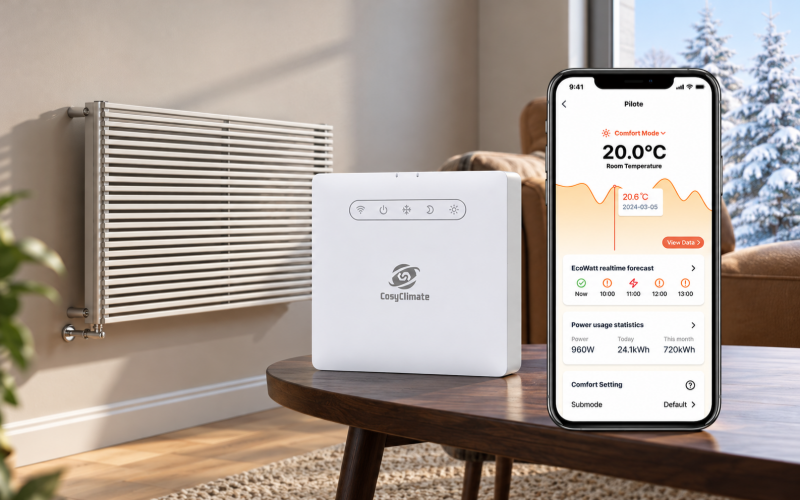
Retaining serviceable electric radiators while making heating schedules more useful across different rooms
Retaining serviceable electric radiators while introducing practical zone-based heating schedules in a French home
In many French homes, electric radiators remain perfectly serviceable even when their controls feel dated. A homeowner may want different heating schedules for bedrooms and living spaces, but replacing every radiator would be an expensive way to solve a scheduling problem.
The existing fil pilote (pilot wire) interface offers another route—provided the installed radiators and wiring are compatible. Rather than switching power to each heater, a suitable programmer can send operating orders to groups of radiators. The radiators continue to regulate their own heating output according to their internal controls.
Application | Existing French residential property with electric radiators |
Existing equipment | Serviceable electric radiators with verified pilot-wire inputs |
Main challenge | Different rooms need different operating periods without replacing the heaters |
Control strategy | Compatible pilot-wire programmer or zone controller with independently configured schedules |
Project boundary | Retain existing radiator heating elements and local temperature regulation where suitable |
Critical check | Radiator mode support, pilot-wire topology, electrical protection and safe installation |
Optional functions | Remote scheduling or supervisory access only where supported by the selected control platform |
The home has electric radiators in its living room, bedrooms and other occupied spaces. The heaters can produce heat, but their independent manual settings do not match how the household uses the rooms. Living areas need comfort during occupied hours; bedrooms often need a different overnight pattern.
A full heater replacement is difficult to justify if the installed units are reliable. The first question is whether their existing pilot-wire connections can be used to organize the home into meaningful heating zones.
Before selecting the programmer, the installer checks each radiator's electrical documentation and wiring. French pilot-wire systems commonly support operating orders such as Comfort and Eco, but the exact number and interpretation of supported orders vary by radiator and programmer. A six-order programmer does not automatically give six usable functions on every installed heater.
· Confirm that the radiator has a genuine fil pilote input, rather than assuming an unused conductor is a control wire.
· Identify the pilot-wire circuit and which radiators are already grouped together at the electrical panel.
· Check whether the proposed zone grouping matches the household's rooms and schedules.
· Verify which orders the installed radiator models actually recognize.
· Have a qualified installer check mains wiring, circuit protection and the programmer's installation requirements.
The pilot-wire programmer does not replace each radiator's internal thermostat. It sends a control order—such as Comfort or Eco—to compatible radiators on a zone circuit. Each radiator then follows that order using its own setpoint or manufacturer-defined temperature offset.
For this home, a practical arrangement separates the main living area from the bedrooms. During the day, the living zone can follow a Comfort schedule while bedrooms remain in a reduced mode. In the evening, those schedules can change without requiring anyone to visit each radiator.
The exact room temperature is not necessarily dictated by the programmer. On many systems, the radiator's local Comfort setpoint remains the reference, and Eco applies a reduction determined by the radiator. That distinction matters when explaining the system to occupants: a pilot-wire command is an operating-mode instruction, not a continuously modulating heat-output signal.
The project only delivers genuine multi-zone control if the electrical topology supports separate pilot-wire groups. If every radiator shares one continuous pilot-wire circuit, a programmer cannot independently command two rooms without changing that control wiring or adding a compatible zoning arrangement.
The installer therefore maps the actual pilot-wire circuits before promising a living-room/bedroom split. Where the existing wiring already separates the required groups, the retrofit can remain relatively limited. Where it does not, the options must be assessed against the cost and disruption of new wiring.
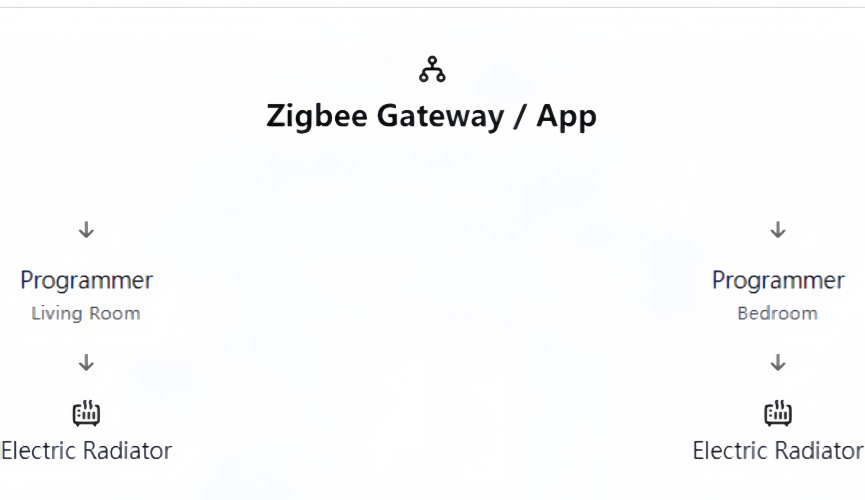
Each radiator retains its own mains supply and local temperature regulation. The pilot-wire connection communicates an operating order; it must not be presented as a replacement for the heater's supply circuit or a universal low-voltage data bus.
Commissioning begins with a circuit-to-room schedule, not with the app or display. The installer records which radiator is on each pilot-wire output, the order set supported by the radiator, and the intended occupied and reduced periods.
· Test one zone at a time and confirm that only the intended radiators respond.
· Check Comfort and Eco behavior on each radiator model; allow for the equipment's own response delay.
· Confirm that the local radiator setpoint remains appropriate, because the programmer cannot correct a badly configured local thermostat.
· Test programmed transitions and the behavior after a power interruption.
· Document the final zone grouping and any radiators with limited command compatibility for future maintenance.
The project should also account for heaters that do not support the same pilot-wire orders. Such devices may require a simpler shared schedule, an alternative compatible interface, or exclusion from the planned zone.
The practical improvement is that heating modes follow room use without replacing functional radiators. Occupants can keep the heaters they know, while the programmer coordinates when groups of rooms should operate in Comfort or reduced modes.
For installers and distributors, the solution addresses a recognizable French retrofit need: adding useful scheduling to an existing electrical heating installation. The value comes from compatibility assessment and correct zone grouping, not from claiming that any pilot-wire product will work with every electric radiator.
Energy consumption may improve where reduced-mode schedules replace unnecessary Comfort operation, but savings depend on occupancy, radiator settings, insulation, climate and existing habits. No fixed saving should be promised.
This approach is strongest where the existing radiators are reliable, fil pilote compatibility is documented, and the pilot-wire circuits can support the desired zone arrangement. It is less suitable where radiators have no compatible pilot-wire input, where circuit topology prevents useful zoning, or where the project needs precise room-temperature telemetry and remote per-radiator temperature setpoints that the selected system does not provide.
Those limitations should be discussed before quotation. A successful retrofit is not defined by the number of commands shown on a product sheet; it is defined by what the installed radiators can actually do.
CosyClimate offers a Pilot Wire Programmer for compatible electric radiator applications. Share the radiator models, supported pilot-wire orders, circuit grouping and required schedules with our team so we can review the intended control arrangement before product selection.
Contact CosyClimate to share radiator models, command modes, circuit layout & zones for French pilot-wire retrofit; we verify compatibility and define control solutions.
Email:info@cosyclimate.com
Phone:+86 13520339098
Add:Tongzhou District, Beijing, 101199 China