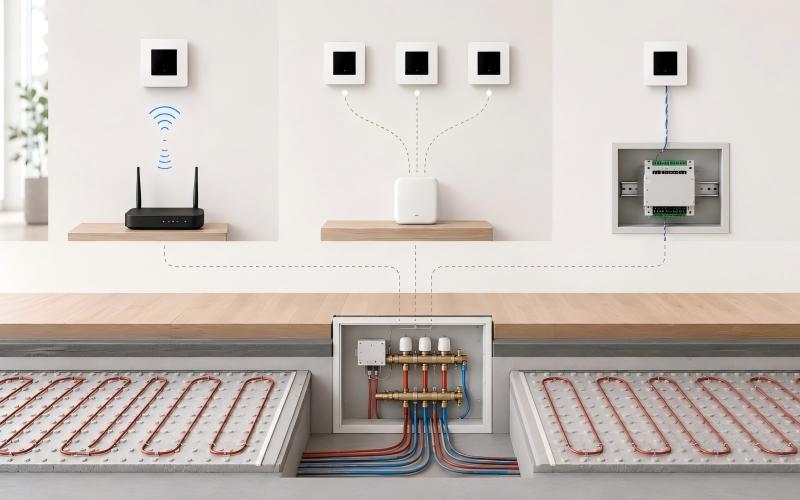
[September, 2026]The communication protocol should follow the heating-control architecture. It should not be the starting point for designing it.Who This Article Is ForThis guide is for HVAC distributors, heating contractors, system integrators, installers, MEP teams and OEM product managers working with water or electric underfloor heating. It focuses on a common specification question: when does WiFi make sense, when is Zigbee the better fit, and when should room thermostats be connected directly to a BMS through Modbus?Quick AnswerWiFi, Zigbee and Modbus solve different problems. WiFi is often practical when individual thermostats need direct app or cloud connectivity and the project is relatively simple. Zigbee becomes attractive when many room devices need to work as one local smart-heating system through a gateway. Modbus is usually the more natural choice when thermostats are part of a professionally engineered building-control system and the BMS needs reliable local data and supervisory control.But protocol should come after the basic heating design. First confirm whether the system is water or electric UFH, how many zones are involved, what each thermostat controls, how boiler or heat-pump demand is generated, and who needs access after handover. Only then does connectivity become a useful decision.1. Start with the Heating System, Not the AppIt is easy for a thermostat enquiry to begin with 'Do you have WiFi?' That is understandable from a product perspective, but it is not enough to design an underfloor heating system.A water UFH thermostat may switch a thermal actuator through a wiring center and indirectly contribute to boiler or heat-pump demand. An electric floor-heating thermostat may switch a substantial electrical load directly and use a floor sensor to protect or regulate the heated surface. Those are different control jobs even if both thermostats appear in the same mobile app.Before choosing communication, establish the load, actuator type, zone arrangement, sensor requirement and heat-source logic. Connectivity sits on top of those functions; it does not replace them.2. WiFi: Simple Direct Connectivity, but Look at the ScaleWiFi is easy for customers to understand. A thermostat connects to the building's wireless network and can support remote control, scheduling or app functions depending on the platform.For a single apartment, small house or a limited number of heating zones, this can be a straightforward architecture. There is no separate Zigbee gateway to position and explain, and each connected thermostat can communicate through the existing IP network.The calculation changes as the number of devices grows. Ten, twenty or more WiFi thermostats are not just ten or twenty copies of a single-device installation. They become part of the site's wireless infrastructure.Ask whether the router and access-point coverage are suitable, whether 2.4 GHz service is available where required, who controls the network credentials, and what happens when the router is replaced. In a rental property or managed building, the person installing the thermostat may not be the person managing the network a year later.3. Zigbee: More Useful When the Heating System Becomes a Network of DevicesZigbee takes a different approach. Room devices communicate through a Zigbee network and a gateway provides the connection to the wider IP or cloud environment where required.This extra gateway can look like additional hardware in a small one-zone installation. In a multi-room heating system, however, centralizing connectivity can make more sense than placing every device directly on WiFi.Zigbee is particularly relevant when the heating system may include several thermostats, radiator controllers, sensors or other compatible devices. The network can also benefit from mesh behavior where mains-powered devices support routing, although actual network performance still depends on device roles, building construction and placement.Do not sell Zigbee simply as 'better range.' Thick reinforced walls, metal cabinets, plant rooms and poor gateway placement can still create problems. A wireless protocol does not remove the need to think about the building.4. Modbus: When the Thermostat Is Part of the Building, Not Just the AppModbus RTU is a different kind of decision. It is usually chosen because the thermostat needs to participate in a building automation or supervisory control system.The BMS may read room temperature, setpoint, operating mode and output status. Depending on the controller and project strategy, it may also write selected parameters or apply occupied/unoccupied commands.This is common in commercial buildings, apartments with centralized management, hotels and other projects where the room thermostat is expected to operate locally while also exposing useful information upstream.Modbus is not automatically the 'professional' choice for every UFH project. A private house with six heating zones does not need an RS485 network simply because it is technically possible. The protocol earns its place when central integration, structured commissioning and long-term building management justify it.5. A Practical ComparisonQuestionWiFiZigbeeModbus RTUTypical roleDirect smart connectivityMulti-device smart heating networkBMS / building integrationExtra infrastructureExisting WiFi networkZigbee gatewayRS485 network and BMS/controllerGood fitSmall residential and direct app controlMulti-room residential and device ecosystemsCommercial or centrally managed projectsProject scaling issueMany devices depend on site WiFiGateway placement and mesh designAddressing, cabling and commissioningInternet required for local heating?Should not be, if local control is designed correctlyShould not be for basic local controlNoMain technical questionIs the IP network suitable and maintainable?Is the Zigbee network designed for the building?Are registers, priority and RS485 design clear?This table is deliberately not a winner-and-loser comparison. The three options belong to different system architectures, and in some projects more than one can exist for different purposes.6. One Thermostat Is Easy. Twelve Zones Change the ConversationA common mistake is selecting connectivity from a single thermostat sample and then multiplying the same idea across the whole property.With water underfloor heating, a larger home may have eight or twelve zones connected to a manifold. The thermostats, actuators, wiring center and heat source have to work together. At that point the question is no longer only whether the homeowner can change the bedroom temperature from a phone.You also need to know how each zone generates demand, how the pump or boiler is enabled, whether schedules are local or centralized, what happens when communication is lost, and how the installer will identify a problem later.A multi-zone heating project should be designed as a system, not as a collection of smart thermostats.7. Water UFH: Connectivity Does Not Replace the Wiring CenterIn many water underfloor heating systems, the room thermostat controls a thermal actuator directly or sends a zone demand to a wiring center. The wiring center may then coordinate multiple actuators and provide pump or boiler demand.Adding WiFi or Zigbee to the room thermostat does not remove this hydronic control logic. The manifold still needs the correct actuator voltage and type, and the heat source still needs a sensible demand signal.For larger installations, check whether the wiring center is wired or RF, how many zones it supports and whether the selected thermostats are intended to work with that architecture.If the boiler runs independently of the zone demand, smart room control may close actuators beautifully while the heat source continues operating for no useful reason. Connectivity cannot compensate for missing system coordination.8. Electric UFH: Load and Floor Sensor Come Before ConnectivityElectric floor heating changes the priority again.The thermostat may be switching the heating load directly, so relay rating and electrical design matter before WiFi or Zigbee is considered. The floor sensor is also important where floor-temperature limitation or floor-based control is required.An app cannot protect a floor covering from excessive temperature if the sensor is missing, incorrectly positioned or configured in the wrong control mode.For distributors, this is an important product-selection distinction. A thermostat that looks identical across water, electric and boiler versions may have very different internal outputs. Make sure the ordered configuration matches the application.9. Think About What Happens When the Network DisappearsHeating is a basic building function. Losing an internet connection should not automatically mean losing temperature control.For WiFi and Zigbee systems, confirm which schedules, setpoints and control functions remain local and which depend on the gateway or cloud service. If the router is offline, can the wall thermostat still regulate the room? If the Zigbee gateway loses internet access, does local device control continue?For Modbus, the equivalent question is what happens when RS485 communication to the BMS is interrupted. Does the thermostat continue its local schedule and setpoint? Does it hold the last central command? Is there a timeout?The right fallback depends on the project, but it should be known before handover.10. Commissioning Effort Should Influence the ChoiceConnectivity adds capability, but it also adds something that has to be commissioned.WiFi devices need network onboarding. Zigbee devices need pairing and gateway organization. Modbus devices need addresses, communication settings, register mapping and RS485 verification.For a homeowner installing two thermostats, a few minutes of pairing may be irrelevant. For a contractor commissioning 150 apartments, repeating an awkward onboarding process can become a meaningful labor cost.Ask how devices are added, named, reset and replaced. If a thermostat fails three years later, the maintenance process should not require rebuilding the whole network.11. Who Will Own the System After Handover?This question often points toward the right architecture faster than a feature comparison.In a private home, the owner may be comfortable managing an app and gateway. In a rental portfolio, changing tenants and WiFi passwords can make direct device-to-router connectivity less attractive. In a commercial building, the facilities team may prefer room controllers that remain part of the BMS and do not depend on individual user accounts.There is no universal answer. The person who commissions the system and the person who maintains it may be different. Design for the second person as well as the first.12. Can WiFi, Zigbee and Modbus Coexist?Yes, provided each connection has a clear job and the product architecture supports it.For example, a room thermostat might use Modbus for BMS integration while WiFi supports another user-facing function. A residential heating system might use Zigbee between room devices and a gateway, with the gateway providing IP connectivity.The danger is adding multiple communication methods without defining control ownership. If an app, gateway, BMS and local user can all change the same parameter, the priority rules need to be explicit.More connectivity is only useful when it creates more control, not more ambiguity.13. What Distributors Should Stock Depends on Who They Sell ToA distributor serving mainly installers doing apartment and house retrofits may see stronger demand for WiFi and Zigbee heating thermostats. A distributor working with building automation companies may need Modbus-capable models and much stronger technical documentation.Trying to keep every communication variant in every appearance and every electrical configuration can create a large inventory very quickly.A more useful portfolio question is: which combinations cover the majority of our customers' real applications? A flexible product family can help, but only if the differences between water, electric and boiler configurations remain clear to the sales team.The aim is not maximum SKU count. It is enough coverage without making product selection harder.14. Questions to Ask Before Choosing the Communication Method· Is the application water UFH, electric UFH or boiler control?· How many independent heating zones are there?· What does each thermostat physically control?· Is a wiring center part of the water UFH system?· How is boiler, heat-pump or pump demand generated?· Does the user need remote app control?· Will several smart heating devices operate as one system?· Is a BMS or building automation platform part of the project?· Who needs to read or change room values centrally?· Who controls and maintains the site's WiFi network?· Where can a Zigbee gateway be installed?· How will Modbus addresses and RS485 segments be commissioned?· What functions continue locally if WiFi, gateway, cloud or BMS communication is lost?· Who will maintain the system after handover?· How will a failed thermostat or gateway be replaced later?15. Choose the Architecture First, Then the ProtocolWiFi is not simply the residential option. Zigbee is not automatically better because it uses a gateway. Modbus is not automatically more professional because it is wired.Each becomes valuable in the right architecture.For a small home where direct app control is the priority, WiFi may be the simplest answer. For a multi-room smart-heating system with several connected devices, Zigbee can provide a more structured device network. For a building where room controls need to sit inside a BMS strategy, Modbus is often the natural fit.The better selection process starts one level below connectivity: understand the heating system, zoning, load, heat-source demand and maintenance model first. Once those are clear, the protocol decision is usually much less complicated. Talk to CosyClimate About Connected Underfloor Heating ControlCosyClimate provides thermostat solutions for water underfloor heating, electric floor heating and boiler applications, with WiFi, Zigbee and Modbus options across different product platforms. Multi-zone heating solutions can also include wiring centers, thermal actuators and related control components.If you are selecting controls for a residential, commercial or OEM project, send us the heating type, zone quantity, actuator or electrical load, required connectivity and any BMS or heat-source coordination requirements. We can help narrow the control architecture before model selection and quotation.Contact CosyClimate to discuss your next HVAC control project.