Hotel FCU Control Retrofit While Keeping Existing HVAC Equipment
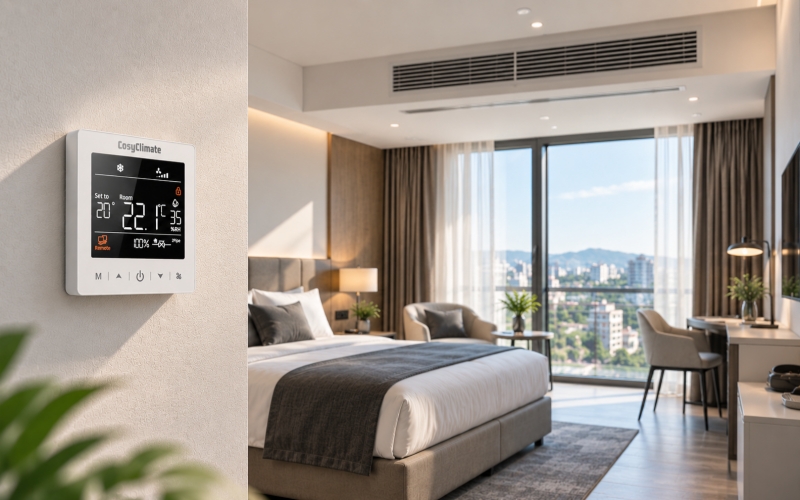
Upgrading guest-room control, occupancy logic and central supervision without turning a controls renovation into a full HVAC replacement
Hotel renovation projects often start with an awkward mismatch: the fan coil units are still mechanically serviceable, but the room controls belong to an earlier generation. Guests notice slow or inconsistent control, engineering teams work with aging thermostats and limited diagnostics, and the existing system may offer little connection to current room-card or building-management requirements.
Replacing every FCU would solve far more than the project actually needs to solve. It would also increase room downtime, ceiling or joinery work, hydraulic intervention and renovation cost. In this application, the retrofit begins by separating the condition of the terminal equipment from the condition of the control layer. The usable FCUs stay; the room-control system is assessed and upgraded around them.
Building Type | Existing hotel / hospitality renovation |
Existing HVAC | Guest-room fan coil units retained where electrically and mechanically suitable |
Retrofit Scope | Room controller and associated control interfaces |
Occupancy Input | Existing or new room-card/key-card signal where required |
Central Integration | Modbus to DDC/BMS where part of the hotel upgrade |
Field Equipment | Existing fan and valve retained or selectively replaced after compatibility checks |
Primary Constraint | Upgrade controls with limited disruption to guestrooms and existing HVAC infrastructure |
Project Objective | Extend the useful life of serviceable FCUs while bringing room operation and management functions up to current project requirements |
The hotel has a large number of guestrooms using fan coil units. The terminals themselves still deliver heating and cooling, so a wholesale mechanical replacement is not justified. The weak point is the room-control layer: old thermostats, inconsistent settings and limited occupancy or supervisory functions.
That makes the project different from a new hotel installation. The controller cannot simply be selected from a specification sheet and installed everywhere. Each existing room type has to be checked against the fan motor, valve, supply voltage, wiring availability and any room-card interface already in place.
The retrofit strategy is therefore based on compatibility first, standardization second. Only after the existing interfaces are understood is a common replacement control platform applied across the rooms that share the same electrical arrangement.
· The hotel wants better guest-room control without replacing serviceable FCUs.
· Existing rooms may contain different thermostat generations or wiring arrangements after years of maintenance and partial renovation.
· Room downtime must be kept short because controls work takes place inside revenue-generating guestrooms.
· The new controller has to match the actual fan and valve interfaces, not merely the nominal FCU type.
· Occupancy logic and BMS integration may need to be added without disturbing the basic local HVAC sequence.
· The engineering team needs a repeatable retrofit method so future service does not recreate the same controller fragmentation.
The new room controller takes over the functions that belong at room level: temperature measurement, fan control and valve control. Where the existing FCU uses a conventional multi-speed AC fan and On/Off valve, the replacement controller is configured around those interfaces rather than forcing a change to the terminal equipment.
If the hotel uses a room-card system, the occupancy signal can be brought into the room-control sequence. The card status does not have to act as a crude master switch. It can be used to move the room between the occupied and unoccupied strategy agreed by the hotel, including any permitted setback behavior.
Where central supervision is part of the renovation, Modbus provides the communication path to the DDC/BMS. The thermostat still controls the FCU locally; the BMS receives the agreed room information and supervisory functions rather than becoming responsible for every fan or valve action.
The most important work happens before the old thermostat is removed. A representative room from each existing control type is surveyed and documented. The contractor checks the wiring diagram where available and verifies it against the field installation.
· Fan type and control method: multi-speed AC, EC or another interface.
· Valve type, operating voltage and whether the existing actuator is suitable for reuse.
· Heating/cooling arrangement, including 2-pipe or 4-pipe logic where applicable.
· Thermostat supply voltage and available conductors at the wall box.
· Room-card signal type and how it is currently used.
· External sensor or changeover inputs, if present.
· Communication cabling and topology if Modbus/BMS integration is being introduced.
This survey prevents a common retrofit mistake: choosing a controller because its front-end functions look correct while the field outputs or available wiring do not match the installed FCU.
Room Card / Occupancy Signal
|
v
New Room Controller <------ Modbus ------> DDC / BMS
|
|---- Fan Output ----> Existing FCU Fan
|
`---- Valve Output --> Existing / Compatible Valve Actuator
Existing FCU coil, casing and hydraulic connections remain in service where suitable.
The architecture deliberately keeps the retrofit boundary clear. The project is replacing or upgrading the control layer, not claiming that every existing field component should automatically be retained. A failed valve actuator, unsuitable fan interface or damaged sensor is replaced where necessary; serviceable equipment is not removed simply because the thermostat is being modernized.
A pilot room is completed for each main existing configuration before the retrofit is rolled out. The installer verifies fan speeds, valve response, heating/cooling operation, temperature sensing and the room-card sequence. If Modbus is included, addressing and the required BMS points are checked at the same stage.
The pilot is also used to confirm the physical installation: whether the new thermostat fits the existing wall box, whether conductor identification is reliable and whether any adapter, relay or wiring correction is required. These details matter when the same work will be repeated across many occupied rooms.
Once the room type is approved, the wiring and parameter set become the retrofit reference. Subsequent rooms are tested against that baseline rather than configured from memory. Any room that does not match the reference is treated as an exception and investigated before connection.
For a working hotel, the installation sequence can then be coordinated with room availability or refurbishment blocks, allowing controls work to follow the operational plan instead of forcing large areas out of service at once.
The hotel retains the mechanical value already present in the FCU system while removing an aging control layer that limited room operation and future integration. Guests receive a more consistent room interface, and the engineering team works with a defined controller platform instead of an expanding collection of legacy thermostats.
Where room-card and BMS functions are included, they become part of a documented control sequence rather than separate add-ons. The hotel also gains a clearer basis for future maintenance because fan, valve, occupancy and communication interfaces have been recorded during the retrofit.
The project does not assume a fixed energy-saving percentage. Any reduction in consumption depends on occupancy strategy, setpoints, FCU condition, central plant operation and actual hotel use. The defensible retrofit value is narrower and more practical: less unnecessary replacement, more consistent room control and a control platform that can be maintained going forward.
· Serviceable fan coil units remain in use, avoiding unnecessary mechanical replacement.
· The retrofit scope can be concentrated on controls, selected field devices and integration interfaces.
· Pilot-room validation reduces the risk of repeating a wiring or configuration error across many guestrooms.
· Room-card logic can be incorporated into a defined occupied/unoccupied strategy instead of simple power interruption.
· Modbus gives the hotel a route to central supervision while preserving local FCU control.
· A standardized replacement platform simplifies future thermostat service, spare stock and engineering documentation.
This approach is well suited to hotels and serviced accommodation where the existing FCUs still perform adequately but room controls have become obsolete, inconsistent or difficult to integrate. It is particularly valuable when renovation must be phased around occupied rooms and when replacing the complete terminal system would add disruption without solving a mechanical problem.
It is not the right answer when the FCUs themselves are at end of life, hydraulically unsuitable, badly corroded or incompatible with the intended renovation. In those cases, retaining the terminal equipment can simply move an unavoidable replacement into the near future. A controls retrofit should begin with an honest condition and interface assessment.
Upgrading Hotel Room Controls Without Replacing Every FCU?
CosyClimate provides fan coil room controllers with options for different fan and valve interfaces, room-card inputs and Modbus integration.
Contact CosyClimate to share thermostat wiring, FCU specs and BMS requirements; we assess and define your repeatable room-control retrofit solution.
Email:info@cosyclimate.com
Phone:+86 13520339098
Add:Tongzhou District, Beijing, 101199 China