Hotel Fan Coil Control with Room Card and BMS Integration
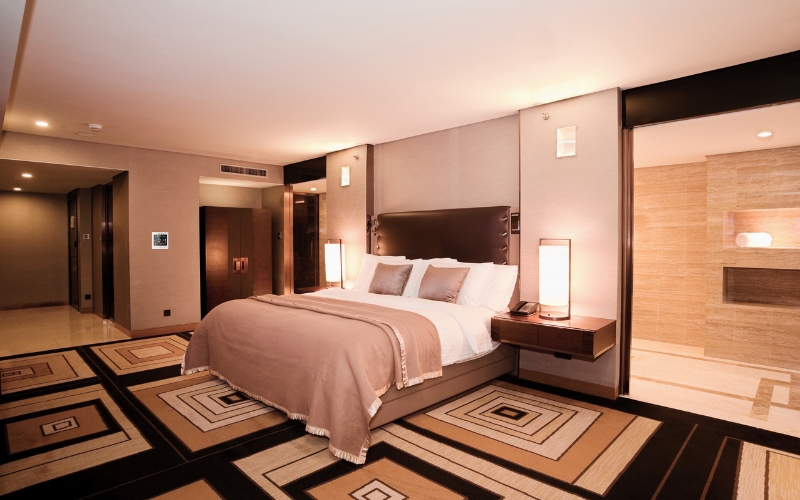
Coordinating guest-room comfort, occupancy status and central HVAC management without overcomplicating room operation
A hotel guest room has a different operating pattern from a typical office. The room may be unoccupied for hours, occupied briefly during the day, or used continuously overnight. Yet the guest still expects the HVAC system to respond quickly and feel simple from the moment they enter.
For the hotel operator, the same room is part of a much larger system. Hundreds of room controllers may need consistent settings, clear operating status and a practical connection to the building-management system. This application brings those two requirements together: local fan coil control for the guest, with occupancy input and optional central supervision for the operator.
Building Type | Hotel / serviced accommodation |
HVAC System | Guest-room fan coil units |
Room Control | Individual thermostat for temperature, fan and valve control |
Occupancy Interface | Room-card input |
Central Integration | Modbus communication to DDC/BMS |
Additional Option | External sensor where the room layout requires a different sensing position |
Project Objective | Maintain straightforward guest control while giving the hotel a more coordinated room-HVAC operating strategy |
The control requirement changes several times during a normal room cycle. Before check-in, the room may be vacant. Once the guest enters and inserts the room card, the HVAC system should be available for normal comfort control. When the guest leaves, the hotel may want the room to move to an agreed unoccupied or setback condition rather than continue operating exactly as if the room were occupied.
This does not mean switching the HVAC system off whenever the card is removed. The actual vacant-room strategy depends on the hotel, climate and building-services design. The room-card signal is therefore treated as an occupancy input to the control sequence, not as a substitute for proper HVAC logic.
A basic fan coil thermostat can control temperature, fan and valve operation. In a hotel, however, the room controller also has to fit into the way the property is operated.
· Guests need simple local control without having to understand the building automation system.
· The room-card status needs to influence HVAC operation according to the hotel's occupancy strategy.
· Fan and valve control must match the actual FCU configuration installed in the rooms.
· The hotel may need centralized visibility or control through DDC/BMS rather than managing every thermostat as an isolated device.
· A repeatable room configuration is important when the same control sequence has to be commissioned across many guest rooms.
The difficulty is therefore not adding one more input to a thermostat. It is making local comfort control, occupancy status and central management work as one coherent room-control sequence.
Each guest room uses a fan coil thermostat as the local HVAC controller. It measures room temperature and controls the fan and water valve according to the selected heating or cooling sequence. The controller configuration is matched to the FCU fan type and valve arrangement used by the project.
The room-card input provides occupancy information to the controller. When the room is occupied, the guest can use the normal comfort settings defined by the hotel. When the room becomes unoccupied, the controller can follow the project's agreed setback or operating logic instead of simply continuing with the last occupied setting.
Where centralized management is required, Modbus connects the room thermostats to the DDC/BMS. The room controller continues to handle the local HVAC sequence, while the supervisory system can work with the points and permissions defined for the property.
Guest / Room Card
|
v
Fan Coil Thermostat <---- Modbus ----> DDC / BMS
|
|---- Fan control ----> FCU fan
|
`---- Valve control --> Motorized valve
Optional external sensor --> Thermostat
The guest interacts only with the room thermostat. The room-card signal changes the operating context, while the DDC/BMS sits above the room controller for supervisory functions. This separation keeps the room usable even though the wider hotel may have a much more sophisticated management system.
For properties using different FCU configurations in different room types, the controller platform can also be selected or configured around the actual fan and valve interfaces rather than assuming that every guest room is electrically identical.
In a hotel project, commissioning room by room without a reference configuration can create unnecessary inconsistency. A better approach is to identify the main room types first - for example, standard rooms, suites or rooms with a different FCU arrangement - and commission a representative room from each type.
The checks include temperature response, fan operation, valve action, room-card behavior and the required Modbus points. The occupied and unoccupied sequences are verified against the hotel's agreed operating strategy before the configuration is repeated across equivalent rooms.
This gives the installer and hotel engineering team a clear baseline for later troubleshooting and replacement, rather than leaving every room with slightly different settings.
The value of the solution is the coordination between room comfort and property operation. The guest still sees a familiar thermostat, but the room no longer has to operate as an isolated HVAC zone.
· Guest-room temperature remains locally controllable during occupied periods.
· Room-card status can be incorporated into an agreed occupied/unoccupied HVAC strategy.
· Repeated room types can use consistent control and commissioning parameters.
· Modbus provides a practical route to DDC/BMS supervision where central management is required.
· The hotel engineering team has a clearer room-control structure for maintenance and future replacement.
· The control platform can accommodate different fan, valve or sensor requirements where room types are not identical.
Energy performance depends on the wider HVAC design, operating setpoints, climate and guest behavior, so the room-card function should not be presented as a guaranteed energy-saving feature by itself. Its real value is that occupancy information becomes available to the room-control strategy instead of being ignored.
This control approach is suitable for hotels, serviced apartments and similar accommodation projects using room-level fan coil systems. It is particularly useful where the property wants occupancy-related room control and centralized HVAC supervision while keeping the guest interface straightforward.
For new projects, the room-card, FCU and BMS requirements can be planned together from the beginning. For refurbishment projects, the existing fan, valve, wiring and room-card interfaces should first be checked so the new controller is matched to the actual field conditions.
Planning Guest-Room HVAC Controls for a Hotel Project?
CosyClimate provides fan coil room-control solutions with room-card input, external-sensor support and Modbus integration, with control options for different fan and valve configurations.
Contact CosyClimate to share FCU type, valve interface, occupancy‑control requirement & BMS architecture for your project; we will match room‑control configuration to the building.
Email:info@cosyclimate.com
Phone:+86 13520339098
Add:Tongzhou District, Beijing, 101199 China