Plug-in Smart Temperature Control for an Existing Electric Heater

A low-disruption retrofit for a suitable electric heater—provided the appliance is designed to resume operation safely after its power supply is switched.
A working electric heater does not always have a useful thermostat. In a small office, spare room or occasionally occupied space, the heater may rely on a coarse mechanical dial or require someone to switch it on and off manually. The owner wants more predictable room temperature and perhaps a schedule, but does not want to alter fixed wiring or replace a heater that still works.
A plug-in temperature controller can sometimes provide that missing control layer. It measures room temperature and switches the supply to a compatible heater according to the chosen setpoint. The important word is compatible: not every portable or plug-in electric heater should be operated by an external power-switching controller.
Application | Small occupied room with an existing plug-connected electric heater |
Existing Equipment | Serviceable electric heater retained if approved for external supply switching |
Customer Problem | Limited temperature control and inconvenient manual operation |
Proposed Approach | Plug-in temperature-sensing controller switching a compatible heater |
Installation Constraint | No alteration to fixed building wiring |
Critical Checks | Heater manufacturer instructions, automatic restart behavior, load rating, socket suitability and safe sensor placement |
Project Goal | Practical room-temperature control with minimal installation disruption |
The room is heated by a plug-connected appliance that can deliver sufficient heat but has limited scheduling or temperature control. Replacing the whole unit may be unnecessary if the owner only needs a more convenient way to regulate when it operates. The first step is not to choose a smart plug; it is to confirm whether the heater is an appropriate load for an external thermostat.
A plug-in controller interrupts and restores mains power. That is fundamentally different from sending a low-voltage thermostat demand to a boiler or a digital command to a smart heater. Some heaters resume their previous setting after power is restored; others remain off, require a button press, or prohibit operation through external switching devices. The latter cannot be made suitable simply by selecting a higher-rated plug.
· Read the heater manufacturer’s instructions. Do not use external supply switching if the appliance prohibits it, requires direct wall connection, or cannot be operated safely in this manner.
· Check the heater’s restart behavior after power returns. An external thermostat cannot control a heater that remains in standby unless the appliance specifically supports that operating method.
· Match the controller’s voltage, current, resistive-load rating and plug/socket standard to the heater and local electrical installation. Consider starting current and the actual load category, not only nominal watts.
· Use an appropriate fixed wall outlet. Do not assume extension leads, multiway adapters or covered sockets are acceptable for a continuous high-load heating appliance.
· Keep the heater’s own overheat and tip-over protections functional. An external controller is not a substitute for appliance safety devices or required supervision.
For heaters with electronic controls, fans, anti-frost functions or delayed shutdown, the manufacturer’s switching requirements need particular attention. If the documentation is unclear, the conservative decision is to use the heater’s intended controls or select a heater designed for external thermostat operation.
Once compatibility is established, the plug-in thermostat measures the room temperature and controls the supply to the heater. A heating call energizes the outlet; reaching the selected threshold disconnects it. The controller’s switching differential and any minimum on/off timing should be suitable for the heater and the intended comfort level.
The room sensor should represent the occupied space. A sensor placed directly beside the heater, in its warm airflow, near a cold external wall or in direct sunlight can cause misleading readings. A remote sensor, if the chosen product supports one, may help when the socket position is unsuitable—but its type and connection must be verified.
Where the controller offers scheduling or connectivity, these functions can reduce manual adjustments. They should be described as optional until confirmed for the selected model. Core temperature regulation should not depend on a cloud connection unless the product’s documented design specifically requires it and that dependency is acceptable to the customer.
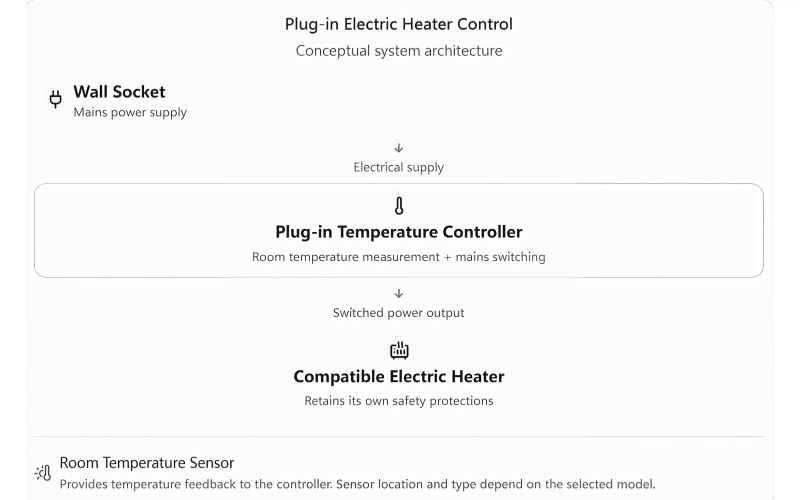
The controller does not change the heater’s internal safety functions, its rated heat output or the building’s electrical capacity. It also cannot make an undersized heater warm a poorly insulated room faster.
The installation may be physically simple, but commissioning should not end when the controller display lights up. The installer or competent user should confirm the heater and controller behave correctly as a pair under the intended operating conditions.
· Document the heater model, its permitted external switching method and its restart behavior.
· Verify the plug/socket condition, load compatibility, placement, clearances and absence of prohibited adapters.
· Create a heating call and confirm that the heater starts as intended; then reach the control threshold and confirm that the heater stops.
· Restore power after a simulated interruption and check that the system returns to a safe, expected state.
· Compare the measured room temperature with a reference at the occupied position and adjust sensor placement if needed.
· Explain which settings belong to the heater and which belong to the plug-in thermostat; retain the appliance’s original safety instructions.
Where the appliance requires manual supervision, the installation must respect that requirement. Remote scheduling is not permission to leave an unsuitable portable heater operating unattended.
For a suitable heater, the upgrade adds a room-based switching decision without opening walls or changing the fixed electrical installation. It may also provide more convenient scheduling if the selected controller supports it. This can be useful in a small room where the heating appliance is still sound but the existing control method is awkward.
The improvement should not be sold as guaranteed energy savings. Consumption depends on room heat loss, thermostat location, setpoints, operating hours and the heater’s performance. The reliable value proposition is a simpler control arrangement and a defined operating schedule—not a claim that a plug-in device increases the heater’s efficiency.
Do not specify this solution for hardwired heaters, appliances that prohibit external switching, heaters that do not restart correctly, loads exceeding the controller rating, or locations where socket placement makes sensing unreliable. A heater with its own well-designed digital thermostat may also gain little from external mains switching.
For multi-room buildings or larger heating loads, dedicated wired controls or an appropriately designed heating system may be more suitable. A plug-in controller solves a narrow retrofit problem; it is not a substitute for building-wide heating design.
The commercial opportunity is not simply selling a connected socket. It is helping a customer determine whether an existing heater can be upgraded safely and usefully. A short compatibility checklist, a clear explanation of temperature sensing and a realistic account of scheduling limitations can prevent returns and misapplication.
This is a typical application scenario, not a documented installation with measured performance results. Any product-specific claims—including maximum load, sensor configuration, scheduling, connectivity and supported heater types—must be checked against the final CosyClimate model datasheet before publication.
CosyClimate can help review temperature-control requirements for suitable plug-connected heating applications.
Contact CosyClimate to share heater model, rated load, manufacturer switching guidance, socket type and desired schedule for pre-selection control verification.
Email:info@cosyclimate.com
Phone:+86 13520339098
Add:Tongzhou District, Beijing, 101199 China