Residential Underfloor Heating Control with Smart Room Thermostats
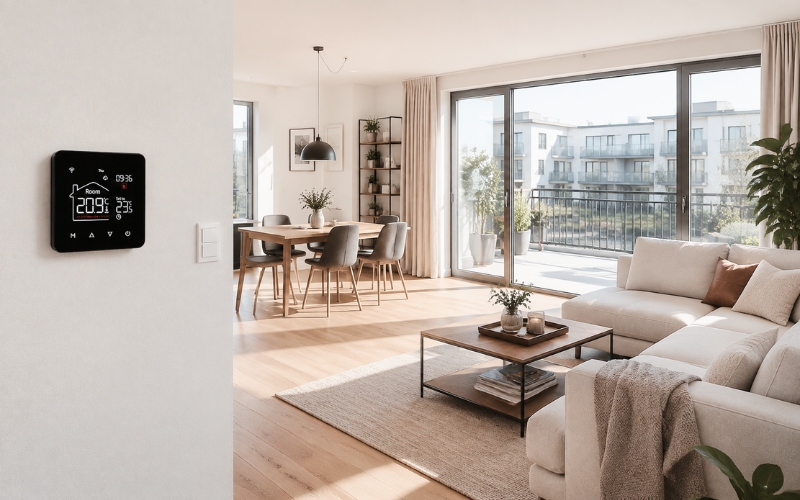
Multi-zone temperature control for a hydronic floor heating application
A residential apartment project required independent temperature control for the living area, bedrooms, bathroom, and other heating zones. The hydronic underfloor heating system provided the required heating capacity, but the room control needed to be organized so that each zone could respond to its own temperature demand.
CosyClimate supplied a room thermostat and actuator control approach for the underfloor heating manifold. Each thermostat controls the actuator assigned to its heating loop, allowing the rooms to operate independently rather than relying on one temperature setting for the whole apartment.
Building Type | Residential apartment |
Heating System | Hydronic underfloor heating |
Control Method | Individual room thermostats with manifold actuators |
Application | Multi-zone room temperature control |
Control Principle | Thermostat heat demand opens or closes the actuator for the corresponding heating loop |
Project Objective | Provide practical room-by-room control, scheduling, and straightforward operation |
The apartment was divided into several heating zones. The living room, bedrooms, bathroom, and other spaces did not need to follow the same temperature setting or the same operating schedule.
For this type of installation, the control task is relatively simple but important: each room thermostat must sense the local temperature and call for heat only when that zone requires it. The corresponding actuator on the underfloor heating manifold then opens the loop and allows warm water to circulate through that zone.
The project therefore focused on the room-control layer rather than changing the heat source or the hydraulic distribution system.
A single central thermostat would not reflect the temperature conditions or occupancy pattern of every room. The installer needed separate control for each heating zone.
Bedrooms, living areas, and bathrooms are used at different times. Keeping all zones at the same setpoint throughout the day would make the system less practical to operate.
Each thermostat needed to provide a clear heating demand to the corresponding manifold actuator so that the correct loop opened and closed at the right time.
The control interface had to remain straightforward for occupants. Common adjustments such as temperature setpoint and schedule changes should not require access to installer settings.
Each heating zone was equipped with an individual room thermostat connected to the thermal actuator serving that zone on the underfloor heating manifold.
The thermostat continuously measures the room temperature and compares it with the user setpoint. When the room requires heat, the thermostat sends a heating demand to the actuator. When the setpoint is reached, the heating demand stops and the actuator closes.
Because each room has its own thermostat and actuator, the zones can operate independently. A bedroom can remain at a lower setpoint while the living area is maintained at a higher comfort temperature.
Weekly schedules can be used to match normal occupancy patterns. Setpoints can be reduced during periods when a room is normally unused and restored before the space is occupied again.
The thermostat platform can be selected according to the project specification. Depending on the model and installation requirements, options can include conventional wired control or connected functions for remote adjustment. The control method should be selected according to the actual project rather than adding communication functions that are not required.
The basic control path for each heating zone is:
Room Thermostat |
↓ |
Thermal Actuator on Manifold |
↓ |
Underfloor Heating Loop |
The boiler or heat pump supplies heated water to the manifold as part of the hydronic system. The room thermostats do not replace the heat source controls; their role is to manage demand at room and zone level.
1. The thermostat measures the temperature in its room.
2. When the measured temperature is below the setpoint, the thermostat calls for heat.
3. The corresponding manifold actuator opens the heating loop.
4. Warm water circulates through the underfloor heating circuit for that zone.
5. When the room reaches the required temperature, the thermostat removes the heating demand and the actuator closes.
Confirm the number of rooms, manifold loops, actuator type, thermostat locations, and available wiring before selecting the control configuration.
Verify operating voltage, output type, actuator compatibility, and the required control logic.
Mount the room thermostats in suitable locations and connect each thermostat to the actuator assigned to its heating zone.
Set temperature limits, schedules, and relevant installer parameters according to the project requirements.
Test thermostat temperature response, actuator opening and closing, zone identification, and heating operation before handover.
After commissioning, each room could be controlled according to its own setpoint and schedule. The control arrangement gave occupants a clearer way to manage comfort in individual spaces and gave the installer a repeatable zone-control structure for the apartment.
· Independent temperature control for the main heating zones
· Automatic opening and closing of each manifold loop according to room demand
· Different schedules and setpoints for rooms with different usage patterns
· Straightforward adjustment for occupants
· A control structure that can be applied to other apartment layouts with similar hydronic underfloor heating systems
No specific energy-saving percentage is claimed for this application because actual consumption depends on the building envelope, heat source, weather, occupancy, setpoints, and operating schedule. The practical benefit of the control upgrade is that heating demand can be managed by room instead of operating all zones in the same way.
Room-by-room control | Each heating zone responds to the temperature in the room it serves. |
Practical scheduling | Different rooms can follow different occupancy patterns instead of using one schedule for the entire apartment. |
Clear control logic | The relationship between thermostat, actuator, and heating loop is easy for installers to understand, wire, and commission. |
Suitable for new build and retrofit work | The same control principle can be applied when planning new underfloor heating systems or upgrading the room-control layer of an existing installation. |
Flexible thermostat selection | The thermostat can be chosen according to the required electrical specification, interface, and communication functions. |
CosyClimate supports HVAC distributors, installers, system integrators, and OEM partners with thermostat solutions for residential heating applications.
Contact CosyClimate for project consultation and customized HVAC solutions
Email:info@cosyclimate.com
Phone:+86 13520339098
Add:Tongzhou District, Beijing, 101199 China