Smart Radiator and Boiler Coordination for Whole-Home Heating Control

Moving beyond room-by-room TRV control by coordinating radiator demand with the central heat source
Smart radiator thermostats can solve an important problem in existing hydronic heating systems: different rooms no longer need to follow the same temperature and schedule. But room-level control is only half of the job. If the radiators can reduce or stop their own heat demand while the boiler continues operating without reference to those room requests, the system is still not working as a coordinated whole.
This application looks at the next step beyond a basic TRV retrofit. Smart radiator thermostats are used for room-by-room control, while a separate demand path communicates the need for heat to the boiler or heat-source interface. The objective is not to make every radiator directly control the boiler. It is to aggregate room demand in a controlled way so the heat source runs when the home actually needs heat.
Building Type | Existing house or apartment with hydronic radiators |
Room Control | Smart radiator thermostats / TRVs on compatible radiator valves |
Connectivity | WiFi or Zigbee depending system architecture |
Central Coordination | Gateway / control logic plus boiler demand receiver or suitable heat-source interface |
Heat Source | Existing boiler or compatible hydronic heat source |
Project Need | Room-by-room control without leaving the boiler disconnected from actual heating demand |
Retrofit Priority | Retain existing radiators and pipework where serviceable |
Main Objective | Coordinate local radiator demand with central heat generation as one heating-control system |
In a conventional radiator system, a central wall thermostat may represent the temperature of only one part of the home. Bedrooms, living rooms and less-used spaces often have very different occupancy patterns, yet the boiler responds to a single central signal.
Adding smart TRVs improves the room side immediately. Each radiator can follow its own setpoint and schedule, and rooms that do not need heat can reduce flow locally. However, the system still needs a clear answer to a second question: when several rooms stop calling for heat, what tells the boiler that central heat production is no longer required?
That is the point of boiler coordination. The TRVs remain local room devices. A separate control layer evaluates heating demand and provides the appropriate call-for-heat signal to the boiler or heat-source interface.
The retrofit therefore has two control levels that need to work together. The first is local: each room decides whether its radiator needs heat. The second is central: the heating system decides whether the boiler should be asked to generate heat at all.
· Living rooms, bedrooms and other occupied spaces need independent temperature schedules.
· Radiators should reduce or stop local flow when their room is satisfied.
· The boiler should receive a heat-demand signal based on actual system demand, not simply continue from a separate unrelated schedule.
· The retrofit should keep the existing radiator network wherever valve compatibility and mechanical condition allow.
· The demand logic must respect the boiler or heat-source interface; a TRV by itself should not be assumed to switch the boiler directly.
· The system needs a fallback and commissioning strategy that remains understandable to installers and future service teams.
Smart TRVs are fitted to compatible radiator valves and assigned to rooms. Their role is to regulate the local radiator according to room temperature, setpoint and schedule. Where Zigbee is used, a gateway provides the network connection for the TRVs; WiFi architectures can use a different communication path depending on the product family.
A central demand function then determines whether there is an active heating requirement somewhere in the home. When one or more defined zones require heat, a boiler receiver or suitable dry-contact interface can provide the call-for-heat signal expected by the boiler. When demand is satisfied, that request can be removed according to the configured control logic.
This is deliberately different from claiming that every smart TRV directly controls the boiler. The room device controls its radiator; the central demand layer coordinates the heat source. That separation makes the system easier to understand and avoids treating a wireless radiator head as if it were a complete boiler controller.
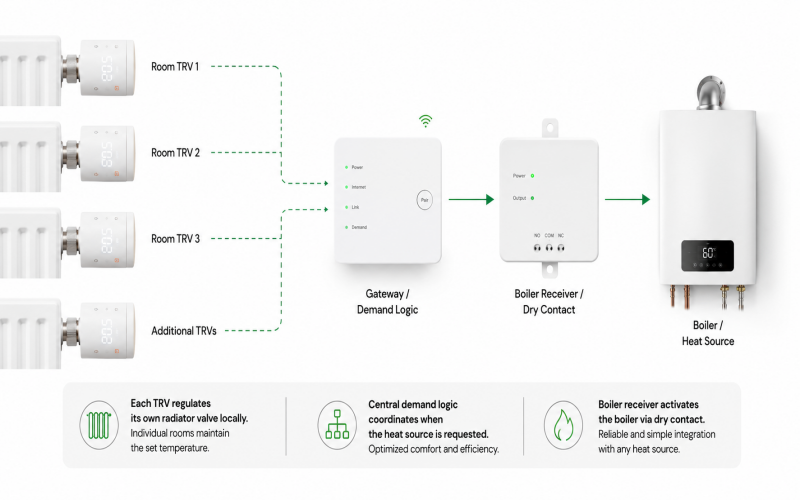
The architecture can vary by product family, but the control responsibilities should remain clear. Room devices manage local radiator demand; the gateway or control layer collects the relevant system state; and the boiler interface provides the electrical demand signal required by the heat source.
A whole-home retrofit is commissioned by checking the system sequence, not just whether each TRV can be paired to an app. The installer first confirms radiator-valve compatibility and verifies that each smart head can physically open and close the valve correctly.
Rooms are then assigned, schedules and setpoint limits are established, and communication with the gateway is checked where required. The boiler-demand path is tested separately: an active room demand should create the expected call for heat, and the request should clear correctly when the defined demand conditions are no longer present.
The final check is hydraulic and operational. If most radiator valves can close at the same time, the existing system must still have an appropriate way to maintain safe and suitable flow through the heat source and distribution system. That requirement belongs to the hydronic design and should be verified rather than assumed to be solved by the controls.
The main improvement is that the heating system begins to respond to the home as a collection of occupied rooms rather than as one temperature zone. A spare bedroom can stay cooler, the living area can follow evening use, and other rooms can run to their own schedules without forcing the entire radiator network to behave the same way.
· Room-by-room temperature control is added without replacing the existing radiator network.
· Local radiator demand and central boiler demand are connected into one control strategy.
· Unoccupied or lower-priority rooms do not have to dictate the schedule for the whole property.
· The boiler can be requested based on defined heating demand rather than operating independently of the smart radiator controls.
· Installers gain a clearer system architecture: radiator control at room level, demand aggregation centrally, boiler switching at the heat-source interface.
· Distributors and integrators can position the solution as a coordinated heating system rather than a collection of standalone smart radiator heads.
Actual energy performance depends on the building fabric, boiler efficiency, flow temperatures, schedules, hydraulic balance and occupant behaviour. The control system should therefore be presented as a way to improve zoning and heat-demand coordination, not as a guaranteed percentage saving.
This approach is particularly relevant to European homes with existing hydronic radiators where the owner wants better room control but does not want to replace the boiler, radiators or distribution pipework. It is also useful for installers who already use smart TRVs but need a more complete answer when customers ask how those room demands should influence the central boiler.
It is not automatically the right architecture for every heating system. Properties with district heating, communal plant, unusual boiler controls or systems that require minimum flow may need a different demand strategy. The heat-source interface and hydraulic conditions should be checked before the control design is finalized.
Planning a Smart Radiator System That Also Needs Boiler Coordination?
CosyClimate provides smart radiator thermostats and heating-control components for room-by-room retrofit applications, with WiFi and Zigbee options and system architectures that can be coordinated with central heat demand where the project requires it.
Share the radiator valve type, number of rooms, boiler interface, preferred communication method and existing heating controls with us. We can help define the room-control and heat-demand architecture before product selection.
Contact CosyClimate for heating system assessment and pre‑selection control architecture definition
Email:info@cosyclimate.com
Phone:+86 13520339098
Add:Tongzhou District, Beijing, 101199 China