Upgrading Existing Underfloor Heating Controls Without Replacing the Heating System
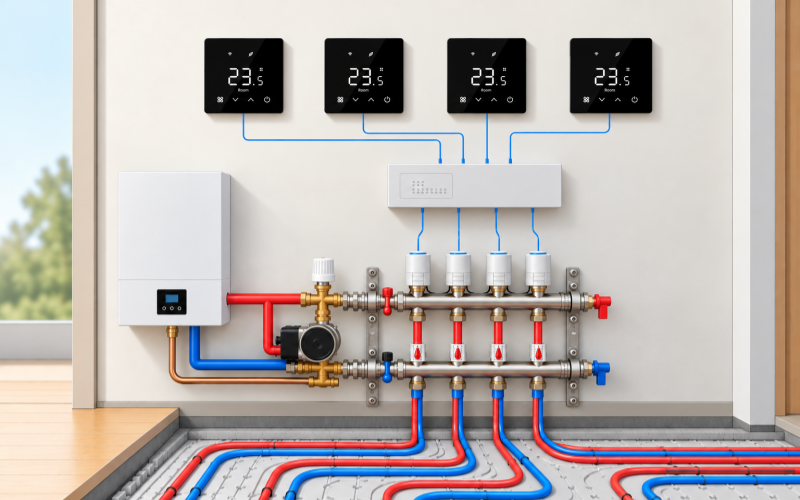
Modernizing thermostats and zone control around a hydronic system that is still mechanically sound
An underfloor heating system can remain mechanically useful long after its room controls have become inconvenient, inconsistent or obsolete. The pipe loops are buried in the floor, the manifold may still distribute water correctly, and the boiler or heat pump may continue to perform well. Replacing that infrastructure simply because the thermostats are dated would turn a controls problem into a much larger renovation.
The better retrofit question is narrower: which parts of the existing system still deserve to stay, and which parts of the control chain are preventing the heating from working the way the occupants now expect? This application keeps the serviceable hydraulic system and rebuilds the room-to-manifold control layer around it.
Building Type | Existing house or apartment with hydronic underfloor heating |
Existing Equipment Retained | UFH pipe loops, manifold and heat source where serviceable and compatible |
Control Upgrade | Room thermostats and zone-control components |
Field Devices | Existing thermal actuators retained only where electrically and mechanically suitable; incompatible or failed actuators replaced |
Zone Coordination | Wiring center where required by the system layout |
Heat Demand | Boiler / heat-pump demand output where the existing plant interface supports it |
Primary Constraint | Improve control without opening floors or replacing a functioning hydraulic heating system |
Project Objective | Restore reliable room-by-room zoning and introduce current control functions while preserving useful existing infrastructure |
The home already has hydronic underfloor heating divided into several room zones. The occupants are dissatisfied with the controls: some thermostats are aging, schedules are limited, replacement parts are becoming difficult to source, and room operation is no longer consistent.
None of those symptoms proves that the floor loops or manifold need replacement. Before defining the retrofit, the installer separates the system into layers: heat source, hydraulic distribution, manifold, thermal actuators, wiring/zone control and room thermostats. Each layer is checked on its own condition and interface.
This avoids one of the most expensive mistakes in heating renovation: replacing hidden or serviceable infrastructure because the visible controls are outdated.
· Existing thermostats no longer provide the scheduling, interface or connectivity expected by the occupants.
· The owner wants room-by-room control without lifting finished floors or replacing embedded pipe loops.
· Existing manifold actuators may use different voltages or operating types, so compatibility cannot be assumed.
· Old wiring may be reusable, but the available conductors and wiring topology must be confirmed before new thermostats are selected.
· The heat source may already have a working demand interface that should be retained rather than redesigned unnecessarily.
· The retrofit must preserve the slow-response nature of underfloor heating instead of applying control behavior better suited to fast-response systems.
A useful UFH retrofit begins at the manifold, not at the thermostat display. The installer first confirms that the manifold, pumps and floor loops are operating correctly and that the system can deliver heat to each circuit.
The existing controls are then documented zone by zone. Thermostat supply voltage, actuator voltage, normally-open or normally-closed behavior, wiring-center terminals, heat-demand contacts and available wall wiring are recorded before any component is removed.
This audit creates a simple but important decision: retain, replace or adapt. A serviceable manifold can remain. A compatible actuator may remain. A failed or electrically incompatible actuator should not be kept merely to minimize the parts list. Likewise, usable thermostat cabling can be valuable, but it should be tested rather than assumed to be correct because it is already in the wall.
New room thermostats become the user-facing control point for each heating zone. Their job is to measure room temperature, apply the selected schedule or setpoint strategy, and send a heat request to the corresponding zone-control output.
At the manifold, a wiring center can coordinate the thermostat signals and thermal actuators. When a room calls for heat, the associated actuator opens the correct manifold circuit. Where the system design requires it, the wiring center can also provide a combined heat-demand signal to the boiler or heat pump.
The hydraulic loops themselves do not need to change simply because the control layer is being modernized. The retrofit succeeds when the new controls are electrically compatible with the retained system and the room-to-loop mapping remains correct.
Thermal actuators are easy to overlook because they sit on a manifold that may have worked for years. But they are the physical link between a thermostat call and water flow through a room circuit.
Before reuse, the installer confirms actuator supply voltage, normally-open or normally-closed operation, connection type and condition. A new thermostat or wiring center cannot correct an actuator that is stuck, mismatched or wired for a different voltage.
If only some actuators require replacement, the decision should still be documented by zone. Mixing old and new devices is acceptable only when their operating logic remains clear for commissioning and future maintenance.
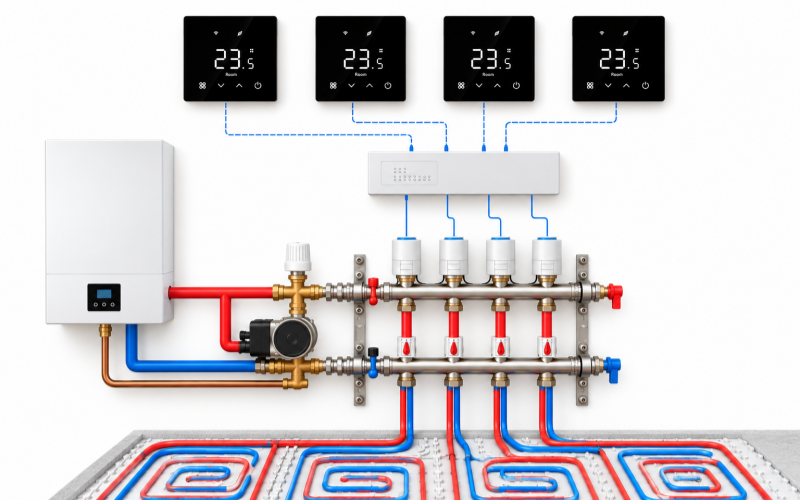
The retrofit boundary is deliberately visible in this architecture. The room controls and, where necessary, actuators or wiring center are upgraded. The manifold, floor loops and heat source remain outside the replacement scope when their condition and interfaces are suitable.
Underfloor heating commissioning should not stop when every thermostat display turns on. Each room thermostat must be proven against the correct manifold actuator and floor circuit.
The installer creates a heat demand in one zone at a time, confirms the corresponding actuator response and checks that the intended floor area begins to receive heat. This is especially important in older homes where manifold labels may be incomplete or previous modifications have changed the original wiring.
Only after the zone mapping is verified should schedules, temperature limits and any smart functions be finalized. If the wiring center provides a heat-source demand output, that sequence is also tested: zone call, actuator operation, plant demand and shutdown.
Because UFH has significant thermal inertia, commissioning should avoid judging the system by immediate room-temperature change. The electrical sequence can be confirmed quickly; the thermal response takes longer.
Modern controls can offer detailed schedules and remote adjustment, but more frequent setpoint changes are not automatically better. A floor slab stores heat and releases it gradually. Large setbacks followed by aggressive recovery may produce slower comfort recovery than occupants expect and can make the system appear unresponsive.
The control strategy should therefore suit the floor construction, heat source and building use. Stable setpoints, moderate scheduled changes and correctly placed sensors are often more useful than constant adjustment.
Where floor-temperature protection is required - particularly in applications with specific floor finishes or electric heating - the correct external sensing strategy must be selected for that system. It should not be assumed that every hydronic retrofit needs the same sensor arrangement.
The home retains the expensive parts of the heating installation that are still doing their job: the embedded pipework, manifold and compatible heat-source interface. The parts that shape everyday operation - thermostats, zone logic and any unsuitable actuators - are brought up to the required control standard.
For the occupants, room control becomes more consistent without a major heating-system replacement. For the installer, the retrofit creates a documented relationship between each room, thermostat, actuator and manifold loop, making later service easier than working with an undocumented legacy control system.
The value of the project should not be expressed as a guaranteed energy-saving percentage. Actual consumption depends on the building envelope, heat source, hydraulic balance, setpoints and occupant behavior. The clear retrofit benefit is avoiding unnecessary replacement while restoring reliable zoning and maintainable controls.
· Retains serviceable UFH pipework, manifold and heat-source infrastructure instead of replacing the complete heating system.
· Updates the room-control layer where occupants actually interact with the system.
· Allows incompatible or failed actuators to be replaced selectively rather than assuming every existing device must remain.
· Re-establishes a clear room-to-manifold zone map during commissioning.
· Supports current scheduling and connectivity options without changing the fundamental hydronic system.
· Creates a more maintainable control platform for future thermostat or actuator service.
This approach is most suitable when the underfloor heating system heats correctly at the hydraulic level but the control equipment is outdated, inconsistent or difficult to maintain. It is particularly attractive in finished homes where opening floors or replacing a sound manifold would add cost and disruption without addressing the real problem.
It is not a shortcut around a failing heating system. Poor flow, blocked loops, damaged pipework, unsuitable water temperatures, a failing heat source or serious hydraulic imbalance must be addressed as mechanical issues. New thermostats can improve control of a healthy system; they cannot repair a hydraulic fault.
Planning an Underfloor Heating Control Retrofit?
CosyClimate provides room thermostats, wiring centers and heating-control components for hydronic underfloor heating applications, including options for scheduling, smart connectivity and project integration.
Contact CosyClimate to share thermostat wiring, actuator specs, manifold layout, heat-source interface & control functions; we assess retainable system parts and control upgrade scope.
Email:info@cosyclimate.com
Phone:+86 13520339098
Add:Tongzhou District, Beijing, 101199 China