Universal Room Control for Mixed HVAC Systems in Commercial Buildings
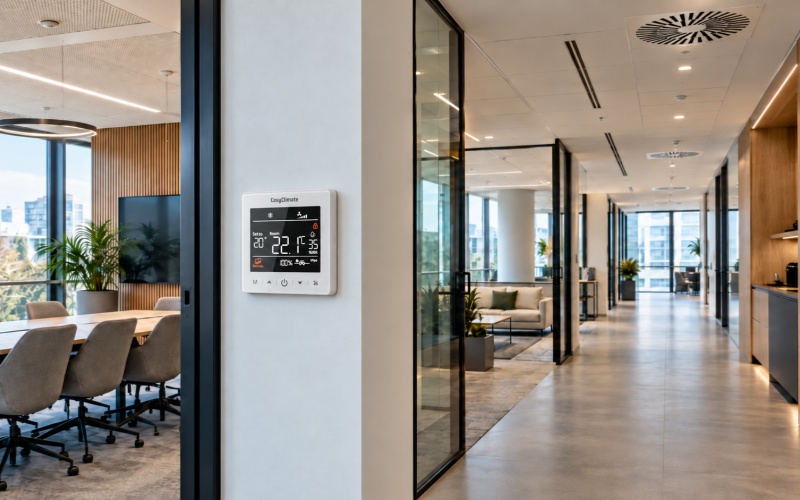
Using one configurable control platform across different fan, valve and room-interface requirements
A commercial building does not always end up with one identical HVAC terminal in every room. Standard office areas may use AC fan coils with On/Off valves, upgraded zones may use EC fans and modulating valves, and other spaces may need a dry-contact signal for compatible DX equipment or a heat-pump interface.
The control problem becomes bigger when every variation brings another thermostat model, another wiring method and another set of commissioning parameters. For this type of project, the useful question is not how many functions a thermostat can offer. It is whether the same room-control platform can be configured around different equipment without making the project harder to specify, install and maintain.
Building Type | Commercial / mixed-use building with different room HVAC configurations |
Project Need | Standardize room control without forcing all terminal equipment into one configuration |
Fan Interfaces | AC multi-speed fan and EC fan |
Valve Interfaces | On/Off valve and 0-10V modulating valve |
Additional Interfaces | Dry contact, room card input and external temperature sensor |
Communication | Modbus and Wi-Fi options according to project requirements |
Typical Applications | FCU rooms plus suitable DX or heat-pump applications using an external dry-contact demand |
Main Objective | Use a common room-control platform while configuring each room for the equipment actually installed |
The building contains more than one terminal arrangement. In the standard office areas, conventional fan coil units use multi-speed AC fans and On/Off water valves. Some refurbished or higher-specification rooms use EC fan motors together with 0-10V valve actuators. Elsewhere, the room controller is required to provide a dry-contact command to compatible DX equipment or a heat-pump control input rather than directly controlling an FCU fan and valve.
There are also room-level requirements that are independent of the terminal type. Selected rooms need a room-card input so HVAC operation can respond to occupancy status, while an external sensor is useful where the thermostat location is not the best place to measure the controlled temperature.
None of these requirements is unusual on its own. The project challenge comes from having to support them together without creating a collection of unrelated room controllers.
Using a dedicated thermostat for every fan, valve and equipment combination can work technically, but it creates a longer-term management problem. The contractor has more models to select and commission, the integrator has more interfaces to document, and the building operator may inherit several different room-control families.
The project therefore called for a controller platform broad enough to cover the main room types, while still allowing each controller to be configured only for the functions needed in that room.
· Conventional FCU rooms needed AC fan and On/Off valve control.
· Variable-output FCU rooms needed EC fan and 0-10V valve control.
· Selected equipment required a dry-contact demand interface.
· Some rooms needed occupancy-related control through a room-card input.
· Remote temperature measurement was required in selected applications.
· The building-management strategy required a consistent path to Modbus/DDC/BMS integration.
CosyClimate's universal controller is used here as a configurable room-control platform rather than as a thermostat tied to one fixed FCU arrangement. The hardware provides the required fan, valve and auxiliary interfaces, while the project configuration determines which functions are used in each room.
In a conventional FCU zone, the controller can operate the AC fan and On/Off valve. In a variable-output zone, the same platform can be configured for EC fan and 0-10V valve control. For a suitable DX split unit or heat-pump interface, the dry contact can provide the external enable or demand signal required by the equipment.
Room-card and external-sensor inputs extend the same platform to applications where occupancy status or sensor position matters. Modbus can then provide the supervisory connection to a DDC/BMS, while Wi-Fi is available for projects where remote connectivity is part of the control concept.
The point is not to switch on every available function in every room. It is to keep one familiar control platform and use only the interfaces that make sense for each application.
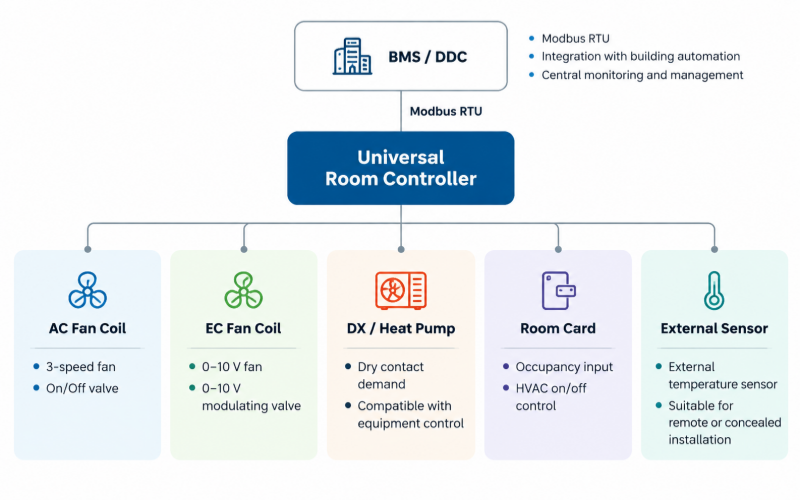
This gives the project team a common control architecture without pretending that every room is the same. The equipment connection and control sequence still follow the actual terminal installed in that zone.
For the DDC/BMS integrator, the advantage is similar: room controllers can follow a more consistent communication approach even when the field equipment behind them differs. Local control remains at room level, while the supervisory system works with the points defined for the project.
The building is first divided into a small number of repeatable room types rather than treating every room as a unique controls problem. For example, the project may define one standard AC fan/On-Off valve room, one EC fan/0-10V valve room and one dry-contact application.
A representative room from each type is commissioned first. The team checks the fan or valve response, dry-contact logic where used, sensor selection, room-card behavior and communication points. Once that configuration is confirmed, it becomes the reference for other rooms using the same equipment.
This is where a universal platform has practical value: standardization happens at the controller and commissioning level, while the HVAC equipment is still allowed to differ where the project requires it.
The strongest benefit is not simply broader compatibility. It is reducing the number of control variants the project has to manage without losing the flexibility needed at room level.
· A wider range of FCU fan and valve combinations can be handled within one controller family.
· Dry-contact capability allows the same platform to cover suitable non-FCU equipment interfaces where an external demand contact is required.
· Room-card and external-sensor inputs avoid adding separate control devices for common room requirements.
· Contractors can work with fewer controller variants and more repeatable commissioning procedures.
· System integrators gain a more consistent route to Modbus/DDC/BMS integration.
· Distributors and OEM partners can cover more project configurations with a more standardized product platform.
For a building operator, the same principle carries into future maintenance: fewer controller families mean fewer interfaces to understand and fewer variants to keep as replacement stock.
This approach is especially useful in commercial buildings, hotels, mixed-use properties and HVAC portfolios where room equipment is not completely uniform. It also suits integrators, distributors and OEM partners that need to support several fan, valve and external-equipment interfaces but want to avoid building a separate control solution around every combination.
Where every room uses exactly the same simple FCU configuration, a universal platform may not be necessary. Its value becomes clearer as the number of terminal types, control interfaces and integration requirements increases.
Working with Different HVAC Configurations in the Same Project?
CosyClimate provides a universal room-control platform covering AC/EC fan control, On/Off and 0-10V valve control, dry-contact interfaces, room-card input, external sensors and Modbus/Wi-Fi options.
Contact CosyClimate to share room types, fan/valve interfaces, external equipment signals and integration requirements. We configure the controller around your actual HVAC system.
Email:info@cosyclimate.com
Phone:+86 13520339098
Add:Tongzhou District, Beijing, 101199 China