Wireless Multi-Zone Heating Retrofit Without Rewiring an Existing Home
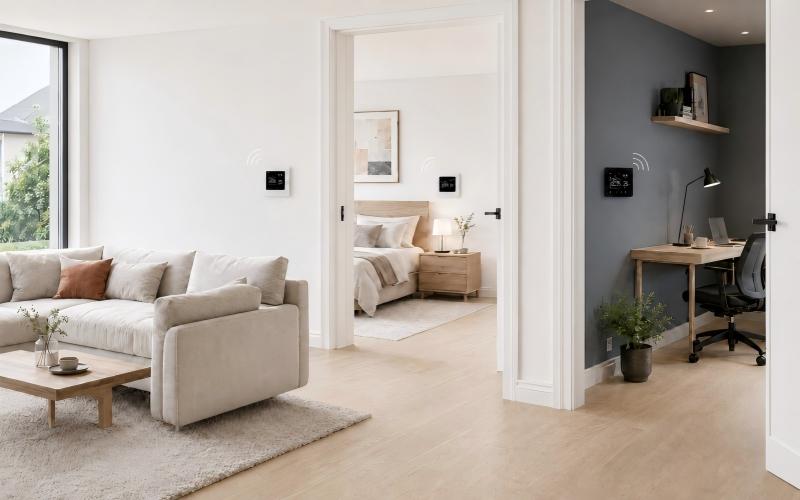
Adding room-by-room hydronic heating control where new thermostat cabling would mean opening finished walls
In an existing home, the heating system can still be mechanically sound while the room controls no longer suit the way the property is used. The obvious upgrade - adding individual thermostats to more rooms - can become difficult when there is no suitable control cable in the walls.
For a finished property, chasing new cables through decorated walls, tiled areas or multiple floors may create more disruption than the heating-control upgrade itself. This application uses wireless room thermostats together with a centrally located multi-zone receiver or wiring center, allowing the existing hydronic heating system to be divided into controllable zones without running new thermostat cables back to every room.
Building Type | Existing house / renovated residential property |
Heating System | Hydronic multi-zone heating, typically manifold-based |
Retrofit Constraint | No practical thermostat wiring available in several finished rooms |
Room Control | Wireless RF thermostats |
Central Control | Multi-zone RF receiver / wiring center |
Zone Output | Thermal actuators controlling individual heating circuits |
Heat Source | Existing boiler or heat pump, subject to the project's demand-control interface |
Project Objective | Introduce independent room zoning while avoiding major wall and cable work |
The property already had a usable hydronic heating installation. The manifold, heating circuits and heat source did not justify replacement, but the existing control arrangement grouped too many spaces together and offered limited room-by-room adjustment.
Several rooms had no suitable thermostat cable at the preferred control position. In some areas, installing new cable would have meant cutting into finished walls; in others, the cable route would have crossed floors or recently renovated spaces.
That changed the design question. Instead of asking how to rewire the whole property for a conventional wired zoning system, the installer needed a way to move the room-temperature signal wirelessly while keeping the actuator and heat-source wiring concentrated around the existing heating equipment.
A useful retrofit should solve the control limitation without creating unnecessary work elsewhere in the system. The design therefore started with the equipment that could remain.
· Keep the existing hydronic heating circuits and manifold where they were still serviceable.
· Avoid new thermostat cable runs through finished rooms.
· Give the main occupied areas independent temperature control.
· Keep actuator wiring close to the manifold rather than distributing mains or control wiring around the property.
· Provide a clear heat-demand path to the boiler or heat pump where the existing system supports that interface.
· Make the finished installation understandable for future servicing, rather than replacing one complicated arrangement with another.
The solution separates the room side from the plant side. Wireless thermostats are installed in the rooms that need independent control. Their temperature demand is transmitted by RF to a multi-zone receiver or wiring center located close to the heating manifold.
The receiver then controls the thermal actuator assigned to that zone. When a room calls for heat, the relevant actuator opens the corresponding circuit. Other rooms remain under their own thermostat control, so a bedroom does not have to follow the same demand as the living area or study.
Where the wiring center provides a suitable heat-demand output, active zone requests can also be coordinated with the existing boiler or heat pump. The exact heat-source connection is confirmed against the equipment interface rather than assumed as part of the wireless thermostat function.
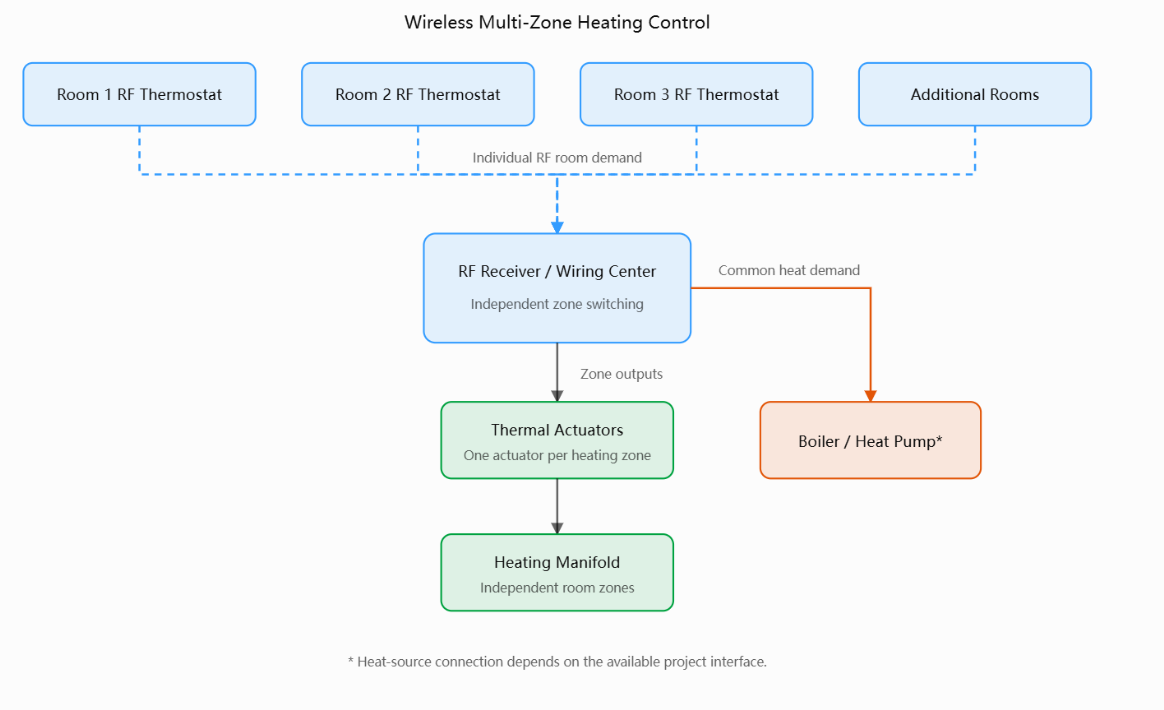
Only the communication between the rooms and the central receiver is wireless. The actuators and heat-demand connection remain part of the fixed heating-control installation around the manifold or plant area. This distinction is important: the objective is not to make the entire heating system wireless, but to remove the difficult room-to-manifold thermostat cable runs.
Wireless control removes a cabling constraint, but it does not remove the need for a proper zoning plan. Before installation, the existing manifold circuits are mapped to the rooms they serve. If one large room uses more than one heating loop, the corresponding actuators are grouped under the same room demand.
The installer also checks the available space and electrical supply near the manifold, actuator voltage and type, the required number of zones, and the heat-source demand interface. RF communication is then tested in the actual property rather than relying only on nominal range, because building construction and equipment location can affect wireless performance.
A representative zone is commissioned first. The thermostat demand, RF link, actuator response and heat-source request are verified before the remaining zones are completed.
The practical value of the solution is the amount of building work it avoids. The heating circuits still need to be understood and commissioned correctly, but the installer is no longer dependent on finding a new cable route from every thermostat position back to the manifold.
· Finished walls and recently renovated rooms can remain largely untouched.
· Existing hydronic heating equipment can be retained where it is still suitable.
· Rooms can be separated into independent control zones according to actual use.
· Actuator and plant-side wiring remains organized around the heating manifold.
· The retrofit can be planned around the real number of zones instead of the limitations of existing thermostat cable routes.
· For installers, the solution creates a practical upgrade path for properties where a conventional wired retrofit would be disproportionately disruptive.
Wireless control does not automatically make the heating system more efficient. The result depends on zoning, schedules, setpoints, hydraulic performance and how the heat source is operated. Its clear advantage in this project is that better room control becomes feasible without rebuilding the finished interior.
This approach is well suited to existing houses, apartments and renovation projects where the hydronic heating system is worth keeping but new room-thermostat wiring is difficult or undesirable. It is especially useful when the manifold and actuator wiring can remain centralized while the thermostat positions are spread across finished rooms.
For a new-build project where suitable control cable can be installed easily, a wired system may still be the simpler choice. Wireless zoning has the most value when it solves a genuine retrofit constraint rather than being used simply because wireless control is available.
Need Multi-Zone Heating Control Without Rewiring the Property?
CosyClimate provides wireless room thermostats, multi-zone RF control solutions and heating-control components for hydronic retrofit projects.
Share the existing heating layout, number of zones, manifold and actuator arrangement, heat-source interface and wiring constraints with us. We can help define a control approach around the property that is already there.
Contact CosyClimate for project consultation and customized HVAC solutions
Email:info@cosyclimate.com
Phone:+86 13520339098
Add:Tongzhou District, Beijing, 101199 China