Workshop Heating and EC Fan Control with 0-10V Outputs
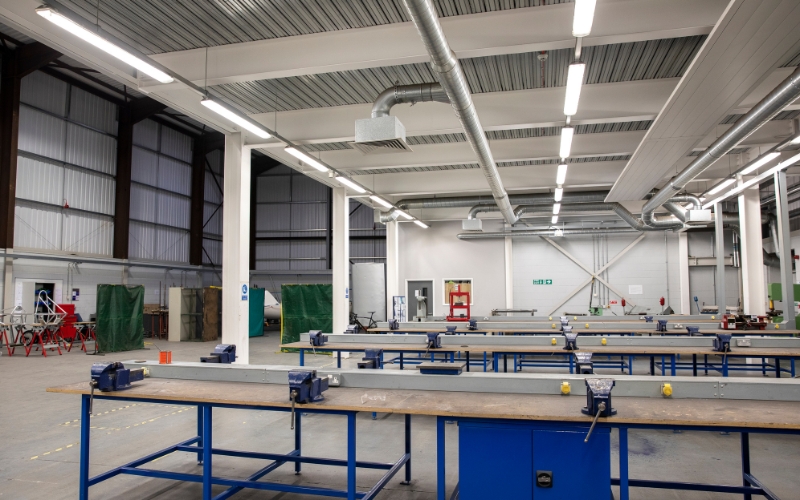
Matching airflow to heating demand in a large working space instead of treating the fan as a fixed-speed accessory
Heating a workshop is not the same control problem as heating an office. The occupied volume is larger, doors may open frequently, internal loads change with production activity, and warm air can collect above the working zone. If the heating terminal uses an EC fan, leaving that fan at one fixed speed wastes much of the control capability already built into the equipment.
In this application, the room controller does more than call for heat. It also provides a 0-10V control signal to the EC fan so airflow can be coordinated with the actual heating requirement. Optional Modbus communication gives a supervisory system visibility where the site needs it, while the local controller continues to handle the room-level response.
Building Type | Industrial workshop / production or service space |
Controlled Zone | Large occupied working area |
Heating Terminal | Compatible warm-air heater, fan-assisted coil or similar terminal with EC fan |
Fan Control | 0-10V EC fan speed command |
Heating Control | Compatible heating enable / valve / heat-demand interface according to equipment design |
Room Control | Local temperature controller |
Central Supervision | Optional Modbus to DDC/BMS or industrial supervisory system |
Project Objective | Coordinate heat delivery and airflow so the terminal responds to changing workshop demand without unnecessary fixed-speed fan operation |
The workshop uses a fan-assisted heating terminal to deliver heat into a large occupied space. The EC motor accepts a 0-10V speed command, but the original operating concept would have used the fan at a fixed or manually selected output whenever heating was enabled.
That approach can be adequate for simple equipment, but it does not make good use of an EC fan. On mild days or during periods with higher internal heat gains, full airflow may be unnecessary. After a large door has been open or the space starts from a lower temperature, the same zone may temporarily need a stronger response.
The control strategy therefore treats fan speed as part of the thermal response. Temperature demand establishes how much heating is required, and the EC fan command is adjusted within the limits defined for the terminal and the space.
· The workshop load changes with outdoor conditions, door activity, occupancy and production heat gains.
· A fixed-speed fan can create excessive airflow and noise during low-load periods while offering no extra control resolution.
· Large spaces respond differently from small rooms; sensor position and air distribution strongly influence control quality.
· The fan and heating output must be coordinated so airflow is not modulated independently of the terminal's safe heating sequence.
· The site may need central status or supervisory access without making basic heating dependent on a BMS connection.
· The controller's 0-10V signal must be electrically compatible with the EC fan input and referenced correctly.
A room controller measures the workshop temperature and determines the local heating demand. The heating output operates the compatible valve, enable contact or heat-demand interface required by the terminal. In parallel, a 0-10V output provides the speed reference for the EC fan.
The important point is coordination. The fan signal is not simply a second output that happens to vary from 0 to 10V. Its operating range and response should be configured around the heater. Minimum useful airflow, maximum permitted speed, heating enable conditions and any run-on requirement are established during commissioning.
Where the project includes a DDC/BMS or industrial supervisory system, Modbus can expose the agreed room values and operating states. The room controller still performs the local control loop, so loss of supervisory communication does not have to remove normal room-level heating control.
An EC fan gives the controls designer a continuous speed reference rather than only a few fixed stages. That does not mean the fan should continuously chase every small temperature change. In a large thermal zone, an overly aggressive signal can create unstable airflow and unnecessary speed variation.
A better sequence uses a defined control band. As demand increases, fan output can rise progressively between configured minimum and maximum limits. As the room approaches setpoint, airflow can reduce rather than dropping abruptly from full speed to off.
This is especially useful where the heating terminal has enough capacity to operate across a range of airflow conditions. The final relationship between heat output and fan speed must still follow the equipment manufacturer's limits; the room controller should not be used to force an airflow condition the heater was not designed to tolerate.
In a workshop, temperature can vary significantly with height and location. A sensor placed near a large external door may see repeated cold-air disturbances. One mounted high on a wall can read warmer air than the occupied working zone. A sensor close to machinery may be influenced by process heat.
The control point should therefore represent the area whose comfort or process condition matters. Where the controller itself cannot be mounted in a representative position, an appropriate external sensor can be considered if supported by the selected control solution.
Before final commissioning, the measured temperature should be compared with conditions in the occupied zone during normal operation. Changing a setpoint to compensate for poor sensor placement is not a substitute for correcting the sensing strategy.
Workshop Temperature / External Sensor
|
v
Room Controller
| |
| `---- 0-10V ----> EC Fan Speed Input
|
`---- Heating Output ---------> Valve / Heater Enable*
Optional Modbus
|
v
DDC / BMS
* Interface depends on the actual heating terminal and must be confirmed before connection.
The controller coordinates the local terminal directly. Modbus, where used, is the supervisory path rather than a device placed in series between the controller and the fan or heating output.
Commissioning starts by confirming the terminal rather than assuming every EC fan uses the same control arrangement. The installer verifies the fan's 0-10V input specification, common/reference requirements, minimum command behavior and what the fan does at 0V or on signal loss.
The heating interface is checked separately. Depending on the terminal, the controller may operate a valve, relay or external enable circuit. If the connected load exceeds the controller output rating or requires safety interlocks, the appropriate relay, contactor or equipment control circuit remains part of the design.
The fan minimum and maximum commands are then tested under actual operation. The minimum setting must still provide useful and safe airflow for the heater; the maximum should suit the space rather than automatically being left at 100 percent.
Finally, the sequence is observed from a colder condition toward setpoint. The team checks that heating and airflow increase logically, that the zone does not cycle excessively around setpoint, and that any fan run-on or heater shutdown sequence follows the terminal requirements.
The workshop heating terminal now responds with two coordinated variables: heat demand and airflow. The EC fan is no longer reduced to a fixed-speed device, and the room controller can lower fan output when full airflow is unnecessary while increasing it when the zone requires a stronger response.
For the operator, the control remains room-based and understandable. For the contractor or integrator, the 0-10V interface provides a practical way to use modern EC fan capability without adding a separate fan-speed controller. Where Modbus is included, the workshop zone can also become visible to the wider site-control system.
The application does not imply a guaranteed energy-saving percentage. Fan-energy and heating results depend on the motor, terminal design, control range, operating hours, workshop load and building envelope. The defensible project value is better matching of airflow to thermal demand and a clearer control sequence for variable-output equipment.
· Uses the EC fan's variable-speed capability instead of operating it as a fixed-speed terminal.
· Coordinates fan airflow with room heating demand at the local controller.
· Allows minimum and maximum fan commands to be matched to the actual terminal and workshop conditions.
· Keeps basic heating control local while supporting optional Modbus supervision.
· Provides a clearer commissioning path for fan signal, heating interface and sensor location.
· Creates a scalable control concept for workshops using compatible 0-10V EC fan equipment.
This approach is relevant to workshops, service bays, light-industrial spaces and other large occupied areas using compatible fan-assisted heating equipment with an EC fan speed input. It is particularly useful where the thermal load changes enough for variable airflow to have operational value.
It should not be applied simply because an EC fan has a 0-10V terminal. Some equipment uses its own internal controller, requires a specific enable sequence or limits the permitted relationship between fan speed and heat output. Process ventilation, smoke control and safety ventilation also require their own engineering logic and should not be treated as ordinary room-temperature control.
Working with EC Fan Heating Equipment in a Workshop?
CosyClimate provides configurable HVAC room-control solutions with 0-10V EC fan control, heating/valve outputs, external sensing options and Modbus connectivity for compatible applications.
Contact CosyClimate to share HVAC details for customized, equipment-aligned room control sequences.
Email:info@cosyclimate.com
Phone:+86 13520339098
Add:Tongzhou District, Beijing, 101199 China