Welcome to CosyClimate
Navigation
Position:Home > News
News
[August, 2026]Replacing an old room thermostat is often easy until the wall is opened and the wiring tells a different story.Who This Article Is ForThis guide is for heating installers, HVAC contractors, distributors, wholesalers, retrofit specialists and product managers dealing with existing boiler-heating systems. It focuses on a common renovation problem: the old thermostat location has only two usable wires, while the replacement is expected to offer modern control without unnecessary rewiring.Quick AnswerTwo wires at an old thermostat do not automatically tell you what replacement thermostat to use. They may simply form a switching circuit to the boiler, and they may not provide the power required by a new electronic thermostat.Before choosing the replacement, identify what those wires actually do, check the boiler control terminals and confirm how the new thermostat is powered. Where suitable power is unavailable at the wall, a battery-powered arrangement or an RF thermostat with the receiver near the boiler may be more practical.1. Why Two-Wire Retrofits Cause So Much ConfusionMany older room thermostats were little more than a switch in the boiler control circuit. Two conductors were enough because the thermostat did not need a permanent supply for a display, WiFi module or other electronics.A modern thermostat may need power as well as a switching connection. That is where a replacement that looks simple in a catalogue becomes awkward on site. Do not treat 'two wires' as a thermostat specification. Treat it as a reason to inspect the circuit.2. Find Out What the Existing Two Wires Actually DoBefore disconnecting anything, identify the existing thermostat terminals and check the boiler wiring information. The aim is to understand whether the conductors form a simple control contact, carry a particular control voltage, or belong to another manufacturer-specific interface.Photograph and label the original connections before removal. Do not assume that any pair of wires can be connected to any dry-contact thermostat simply because the old controller opened and closed a circuit.3. Dry Contact Is a Control Function, Not a Power SupplyThis distinction clears up a surprising number of selection errors. A dry-contact output behaves like an isolated switch: it opens or closes the boiler control circuit, but it does not power the thermostat electronics.The thermostat may still need batteries, 230V or another designed power source. Ask two separate questions: How is the thermostat powered? How does it signal the boiler? The wiring diagram should answer both.4. The Common Retrofit Problem: No Neutral or Permanent Power at the WallIn a new installation, providing the correct cable is usually straightforward. In a finished home, adding conductors can mean opening walls, lifting floors or accepting visible trunking.If the old thermostat position only contains conductors used for boiler control, a mains-powered smart thermostat that expects line and neutral may not be a direct replacement. At that point, choose the control architecture around the building condition rather than forcing the preferred product into the old wiring.5. Three Practical Ways to Approach the RetrofitA battery-powered thermostat can be attractive where the existing control pair can still be used correctly and bringing new power to the wall would add unnecessary work. Battery life and low-battery indication then become normal maintenance considerations.An RF thermostat and receiver can move the wired switching function back to the boiler. The room unit communicates wirelessly while the receiver is installed where suitable power and boiler terminals are available. Wireless does not mean no wiring—the receiver still needs correct installation—but it can avoid difficult wall work.During a larger renovation, new wiring may simply be the better long-term answer. If walls are already open, providing the correct supply and control cable can be inexpensive. The same work in a finished apartment may be hard to justify.6. Do Not Confuse Two-Wire Control with Two-Wire PowerThe phrase '2-wire thermostat' is too vague on its own. For one product it may mean a battery-powered controller using two conductors only for boiler switching. Another system may use a specially designed powered interface.For installers and distributors, describe the application explicitly: thermostat power source, boiler output type and required field wiring. That prevents a customer ordering a '2-wire model' based on the phrase alone.7. Check the Boiler Side Before Finalizing the ThermostatThe wall is only half of the job. The boiler terminals decide how the heat source expects to be controlled.Check the external thermostat terminals, the required control interface and electrical rating, whether a factory link must be removed, and whether an existing timer, programmer, receiver or zone control remains in the circuit. If the boiler documentation is unclear, do not guess.8. What Changes When the Customer Also Wants WiFi?This is where many retrofit enquiries become more interesting. The customer wants app control, but the thermostat position was never wired to power a connected device.WiFi electronics need a reliable power source. If the proposed WiFi thermostat requires mains power, an old two-wire wall location may not support it directly. In some projects it is cleaner to separate room control from boiler wiring through an RF receiver architecture; in others, planned renovation work makes new wiring sensible.Decide which requirement is essential: minimal disruption, app control, thermostat location or future expandability. The answer can change the product architecture.9. Surface Mounting Can Be an Advantage in Existing BuildingsEmbedded thermostats look neat when the correct wall box, wiring and supply already exist. Retrofit work does not always offer those conditions.A surface-mounted thermostat can avoid unnecessary cutting where the existing back box is incompatible or absent. Installation format is therefore not only an aesthetic choice; it affects labor and how much of the finished wall must be disturbed.10. Think Beyond the Thermostat If the Boiler Also Serves Underfloor HeatingSome boilers serve radiators and underfloor heating through manifolds, wiring centers, pumps or valves. In these homes, replacing the main boiler thermostat should not be treated as an isolated wall-control job.Check which devices currently create boiler demand and how the UFH zones are coordinated. A thermostat that suits a simple boiler-only apartment may not be the right architecture for a property with several heating zones.11. A Small Site Check Can Prevent the Wrong Product Being QuotedFor volume retrofit enquiries, ask for more than quantity. A photo of the existing thermostat wiring, the boiler model or terminal diagram, whether WiFi is required, whether rewiring is acceptable and whether other heating zones are present can change the recommendation completely.It is better to discover that before 100 thermostats are shipped.12. Common Mistakes in Two-Wire Boiler Thermostat ReplacementAssuming two existing wires can power a new electronic thermostat; selecting by appearance or app features before checking the boiler interface; treating dry contact as a power source; ordering a mains-powered wall thermostat where no suitable supply exists; forgetting that an RF receiver still needs correct boiler-side wiring; and ignoring existing programmers, zone valves or UFH controls.13. A Practical Pre-Order ChecklistConfirm the boiler make and model; existing thermostat terminals; function of the two wall conductors; available power and neutral; thermostat power requirement; boiler control interface; surface or embedded mounting; whether rewiring is acceptable; whether RF would simplify the job; connectivity requirements; other heating zones; and any existing timer, receiver or zone controls. For a volume project, check at least one representative installation before ordering.14. The Best Retrofit Usually Works with the Building, Not Against ItAn old two-wire thermostat connection is not necessarily a problem. It is simply a constraint that needs to be understood before the replacement is selected.In some homes a battery-powered arrangement is the cleanest answer. In others, moving the switching function to an RF receiver beside the boiler avoids difficult wall work. During a larger renovation, new wiring may be the better long-term choice.The useful question is not 'Which modern thermostat can replace this old one?' It is 'What control architecture gives this building the functions it needs with the least unnecessary work?' Talk to CosyClimate About Boiler Thermostat RetrofitCosyClimate provides boiler thermostat options for different retrofit and new-installation requirements, including battery and 230V powered models, wired and RF wireless solutions, WiFi and Zigbee connectivity, surface-mounted and embedded formats, and configurations for boiler-only or boiler-plus-underfloor-heating applications.If you are selecting a thermostat for an existing installation, send us the boiler model, current wiring, available power, required connectivity and whether rewiring is possible. We can help narrow the suitable configuration before quotation.Contact CosyClimate  to discuss your next HVAC control project.
[August, 2026]A good hotel room control strategy should disappear into the guest experience while still giving operators enough control to manage energy, maintenance and the building as a whole.Who This Article Is ForThis guide is for hotel HVAC contractors, MEP consultants, system integrators, building automation companies, hotel engineering teams, FCU manufacturers and distributors involved in new-build or renovation projects. It focuses on the room-control decisions that should be settled before thermostat models are ordered or BMS points are mapped.Quick AnswerHotel room HVAC control has to satisfy two very different users. The guest wants a room that reaches a comfortable temperature quickly and is simple to operate. The hotel wants sensible temperature limits, reduced operation in unoccupied rooms, reliable fan coil control, centralized visibility and a system that maintenance teams can support for years.Define those operating rules first. Confirm the fan coil type, fan and valve signals, occupancy or key-card logic, allowable guest adjustment, BMS requirements and what should happen when a room becomes vacant. Then select the thermostat around the sequence, rather than asking the thermostat to define the sequence after installation.1. A Hotel Room Is Not Just Another Thermostat ZoneAt first glance, a hotel bedroom looks simple: one room, one fan coil and one thermostat. In practice, its operating pattern is very different from an office or private home.The person using the controls changes constantly. Rooms can sit empty for hours or days. Housekeeping enters when the guest is away. Engineering teams may need room status while the BMS only needs a selected set of control points.The controller therefore has to manage transitions between occupied, temporarily unoccupied and vacant conditions without making those transitions irritating to the guest. A technically sophisticated sequence that produces complaints at reception is not a good hotel control strategy.2. Start with the Room Operating SequenceBefore discussing display design, WiFi or Modbus, write down what the room should actually do.What happens when a guest checks in? What temperature range can the guest select? What happens when the key card is removed? Does the fan stop, move to automatic control or continue for a delay? What happens to the setpoint after checkout?These questions determine the controller configuration and often expose conflicts between energy-saving expectations and guest comfort before they become commissioning problems.2.1 Define Occupied and Unoccupied ProperlyA key-card input is commonly used as an occupancy signal, but it is not perfect proof that a room is empty. Guests may leave briefly, some cards remain in holders, and housekeeping may enter with a staff card. Other hotels combine room control with door contacts, occupancy sensors or management systems.Design around the information that is actually available. If key-card presence is the only signal, do not build a sequence that assumes the controller knows more than it does.2.2 Do Not Automatically Switch Everything OffTurning HVAC off as soon as the guest leaves can allow the room to drift too far from a comfortable temperature, particularly in hot, humid or very cold conditions.A setback strategy is often more practical: relax the heating or cooling setpoint while the room is unoccupied, then restore the normal guest range when occupancy returns. The setback should suit the climate, building envelope, FCU capacity and hotel policy—not a universal number copied from another project.3. Match the Thermostat to the Fan Coil Before Adding Smart FunctionsHotel control discussions can move quickly toward BMS integration and room automation. The basic FCU interface still has to be correct first.Confirm whether the project uses 2-pipe or 4-pipe fan coils, traditional AC fans or EC fans, and On/Off or 0–10V valves. Also confirm how heating/cooling changeover is handled in a 2-pipe system.Do not assume every room in a renovation has the same FCU because the guestrooms look identical. Equipment may have been replaced floor by floor over the years. A short site survey can reveal mixed fan or valve types that materially change the control requirement.4. Guest Control Needs Limits, but It Still Has to Feel Like ControlHotels usually do not want unrestricted setpoints. At the same time, a thermostat that appears to accept a setting and then quietly ignores it is frustrating.A better approach is to define a reasonable guest adjustment range and make the controller behave consistently inside it. Advanced parameters can sit behind the interface; guests should not need an instruction manual to change temperature or fan mode.5. Fan Control Has a Direct Effect on What the Guest NoticesGuests may never know which valve signal is being used, but they notice fan noise immediately.Traditional AC fan coils normally use discrete fan speeds. If high speed is selected too aggressively, recovery may be quick but noisy. If the fan remains too low, a room that has been vacant can take too long to recover.EC fans allow finer 0–10V speed control, but the control curve still has to suit the actual FCU. For a sample room, listen as well as measure. A sequence that looks good on a laptop can sound very different at the bed.6. Key Card, Occupancy and Door Signals Need a Clear PriorityHotel rooms can have several signals influencing HVAC operation. Problems appear when nobody has decided which one wins.Consider a room where the key card is removed, the balcony door is open and the BMS is sending an occupied command. Should cooling continue? Should the valve close? Is there a delay? What happens when the door closes again?The answer depends on the hotel concept, but the priority should be written before commissioning. More signals do not automatically create better control; use the information that genuinely improves the room sequence.7. Decide What the BMS Actually Needs to SeeConnecting every possible thermostat parameter to the BMS can create a large point list without creating much operational value.Ask the hotel engineering team what they will actually use. Useful points may include room temperature, setpoint, operating mode, fan status, valve demand, occupancy state and communication status.If the BMS can write setpoints or modes, define the relationship with local guest control. Otherwise the guest changes a setting, the BMS changes it back, and both systems appear to be malfunctioning. A smaller, well-defined point list is often more useful than exposing every internal parameter.8. WiFi and BMS Communication Solve Different ProblemsWiFi and BMS communication are sometimes discussed as though one replaces the other. In hotel projects they usually serve different purposes.Modbus or another BMS connection belongs to the building engineering architecture. WiFi may support configuration, app functions or another connectivity layer. The useful question is: who needs to communicate with the room controller, for what purpose, and what should still work if that connection is unavailable?Local fan coil control should remain sensible even when an external network is temporarily unavailable.9. Temperature Sensing Deserves More Attention Than It Usually GetsA controller can only regulate well if the temperature it sees represents the space.A thermostat near the entrance, in direct sunlight, beside a heat-producing device or in a poorly ventilated recess may not see the same conditions the guest feels near the bed.Before changing control parameters to fix a persistent comfort complaint, check the sensor location. Software cannot fully compensate for a bad measurement point. Where the wall position is unavoidable, an external sensor may be a better reference.10. Standardization Matters More as the Room Count GrowsIn a 12-room property, two thermostat variants may be manageable. In a 300-room hotel, small differences multiply into different wiring, parameter menus, firmware, spare parts and commissioning instructions.Where the FCU systems allow it, a flexible room-controller platform can standardize more of the building. Support for AC and EC fans, different valve outputs, room-card functions, external sensors and BMS communication can reduce unnecessary controller variants.Do not force standardization where applications are genuinely different. The goal is fewer unnecessary variations, not one thermostat at any cost.11. Commission a Sample Room Before Repeating It 200 TimesOne of the most useful steps in a hotel controls project is also one of the simplest: finish a representative room before rolling the configuration across the building.Test it as a guest experiences it, not only point by point from the BMS workstation. Enter from an unoccupied state, check recovery, change the setpoint, remove the key card, listen to fan speeds, confirm valve operation and verify the BMS commands the hotel will actually use.If the sample room needs a parameter change, make it before the same issue is copied to every floor. A few hours here can save days of repetitive correction later.12. Think About Maintenance Before HandoverThe hotel engineering team will live with the system long after the commissioning engineers leave.They need to know which model is installed, which parameters are project-specific, how a replacement is configured and which spare units should be kept on site. Keep final BMS point lists, addresses and approved parameter sets with the project documentation.If a controller is replaced two years later, the maintenance technician should not have to reverse-engineer the original commissioning.13. A Practical Pre-Order Checklist for Hotel Room Controls· Is the fan coil system 2-pipe or 4-pipe?· AC multi-speed fan or EC fan?· On/Off or 0–10V valve control?· How is heating/cooling changeover determined?· Where will room temperature be measured?· What can the guest adjust, and what limits apply?· What happens when the key card is removed or the room becomes vacant?· Are door/window contacts or occupancy sensors part of the sequence?· Which signal has priority if room-status inputs disagree?· Which values does the BMS need to read?· Which parameters should the BMS be allowed to write?· Is WiFi needed in addition to BMS communication?· Can the room operate sensibly if network communication is lost?· Has a representative sample room been commissioned before volume installation?· Are final parameters, addresses, wiring and replacement procedures documented?14. The Best Hotel Room Control Is Usually the One Guests Do Not Have to Think AboutA guest should be able to walk into the room, understand the thermostat in a few seconds and get comfortable without learning the building's control strategy.Behind that simple experience, the project team still has to make careful decisions about fan and valve compatibility, occupancy logic, setpoint limits, sensing, BMS points, network behavior and maintenance.Design the room from the operating sequence outward: start with what the guest and hotel need the room to do, confirm the FCU hardware, then choose and configure the controller that can deliver that behavior reliably. When those decisions are made in the right order, comfort, energy management and central control do not have to compete. Talk to CosyClimate About Hotel Fan Coil ControlCosyClimate provides fan coil thermostat solutions for hotel and commercial room control, including AC and EC fan control, On/Off and 0–10V valve control, Modbus, WiFi, room-card input and external sensing options.If you are specifying a hotel project, send us the FCU type, fan and valve signals, room-control sequence, BMS requirements and expected room quantity. We can help review the control configuration before model selection and quotation.Contact CosyClimate  to discuss your next HVAC control project.
[August, 2026]For HVAC buyers, the lowest thermostat quotation is not always the lowest-cost decision once the product reaches the warehouse, the installer and the project site.Who This Article Is ForThis article is written for HVAC importers, distributors, wholesalers, purchasing teams, product managers and brands evaluating thermostat and HVAC control suppliers. It is not a supplier scorecard and it is not an argument for paying more by default. The purpose is simpler: to identify the costs that often sit outside the quotation but still end up on the buyer’s side of the business.Quick AnswerUnit price matters, especially in a competitive HVAC market. But it should be compared only after the products being quoted are genuinely comparable.A thermostat that is €1 cheaper can become the more expensive choice if it creates extra SKUs, needs more installation time, produces avoidable compatibility questions, arrives with weak technical documentation or generates more replacements and support work. The right comparison is therefore not simply purchase price versus purchase price. It is the cost of getting the product from specification to a stable, supported installation.1. Start by Asking Whether the Quotations Are Actually ComparablePrice comparisons become misleading very quickly when two thermostats look similar on the front but do different work behind the wall.For example, one FCU thermostat may control only a traditional three-speed AC fan and an On/Off valve. Another may also support an EC fan, 0–10V valve control, Modbus communication, external sensing or additional control inputs. In heating products, one boiler thermostat may require mains power while another can work in a two-wire retrofit or through an RF receiver.If those products are placed in the same spreadsheet and compared only by unit price, the cheaper column may be answering a different technical requirement.Before negotiating price, normalize the specification. At minimum, confirm the control outputs, power supply, communication method, installation format, required accessories and certifications. Only then does the unit-price comparison start to mean something.2. The First Hidden Cost Is Usually the Wrong Product for the JobA sourcing mistake rarely announces itself at the purchasing stage. It usually appears later, when somebody tries to install or integrate the product.A few examples are familiar to anyone who works with HVAC controls:· The thermostat has relay fan outputs, but the project uses EC fans requiring 0–10V control.· The valve signal does not match the actuator or motorized valve selected for the project.· The old heating installation has only two usable wires, but the chosen thermostat needs a different power arrangement.· Modbus is listed in the catalogue, but the project team cannot get the register information or commissioning details it needs.· A smart radiator thermostat is ordered in volume before the existing valve bodies and adapters have been checked.None of these problems is solved by a low purchase price. Once goods are in stock or on site, the cost becomes re-selection, freight, labor, delay and sometimes an uncomfortable conversation with the customer.For buyers, one of the most valuable supplier capabilities is therefore not a feature on the thermostat. It is the ability to identify the wrong configuration before the order is placed.3. SKU Cost Is Real, Even When It Does Not Appear on the InvoiceDistributors often look at margin by model. It is also worth looking at the cost of carrying the model itself.Suppose a product range needs separate thermostats for AC fan, EC fan, On/Off valve, 0–10V valve, standalone control and Modbus projects. Each additional version may require its own forecast, minimum stock, product page, training, technical files, spare stock and purchasing attention.That does not mean a universal thermostat is always the right answer. A simple, dedicated model can be exactly right for a stable high-volume application. But where customer requirements vary, a more flexible control platform can reduce the number of versions needed to cover the market.The useful question for a distributor is not 'How many models does this supplier offer?' It is 'How many models do we need to stock to cover the applications our customers actually buy?'4. Installation Time Can Erase a Small Price Advantage Very QuicklyA thermostat is not sold into a vacuum. Somebody has to wire it, mount it, configure it and prove that it works.Imagine two products with a small difference in unit price. If the cheaper product takes an installer even ten extra minutes because the terminals are unclear, the menu is difficult to navigate or the configuration sequence is unfamiliar, that difference can disappear quickly in a commercial project with hundreds of rooms.This is especially important for contractors and integrators, but distributors feel the effect too. Products that are difficult to install tend to create more calls, more returns labelled 'faulty' and more pressure on technical support.Before approving a product, it is worth having somebody who actually installs controls review the terminal layout, mounting method, setup menu and instructions. A purchasing team can compare quotations. An installer can tell you whether the product is likely to create work.5. Commissioning Is Where Documentation Becomes Part of the ProductFor a basic standalone thermostat, a short instruction sheet may be enough. For a controller connected to BMS, Modbus or a more complex HVAC sequence, documentation becomes part of the deliverable.An integrator may need register addresses, data types, writable ranges, operating modes, baud-rate settings, device addressing and clear explanations of how local control interacts with BMS commands. If that information arrives late or has to be reconstructed through repeated emails, the project pays for it in engineering time.This is one area where buyers should test a supplier before a large order. Ask for the technical material that an integrator would need, not only the sales brochure. If the documentation is difficult to obtain before purchase, it is unlikely to become easier during commissioning.6. Quality Consistency Matters More Than a Perfect SampleA good sample is useful, but the real purchasing question is whether production units remain consistent over time.For controls, consistency includes more than whether the screen turns on. Terminal quality, relay behavior, sensor accuracy, plastics, touch or button response, firmware, wireless performance and packaging all affect what the customer receives.This becomes more important when a distributor builds repeat business around a product. If a replacement unit behaves differently from the unit installed six months earlier, the problem is not only a warranty cost. It weakens installer confidence in the whole range.Ask what happens when components, firmware or production processes change. A supplier does not need to promise that nothing will ever change; that would be unrealistic. What matters is whether changes that affect compatibility or user experience are controlled and communicated.7. Warranty Cost Is More Than the Price of a Replacement ThermostatA returned thermostat may cost €20, €30 or €50 to replace. The replacement unit is often the smallest part of the real cost.There may also be freight, administration, troubleshooting time and an installer visit. If the thermostat is installed in an occupied hotel room, apartment or office, arranging access can cost more than the product itself.This is why a warranty percentage should not be viewed in isolation. Buyers should also ask how faults are diagnosed, how quickly technical questions are answered, whether spare units are available and how repeat issues are handled.Good after-sales support does not mean approving every return without investigation. It means reaching the correct diagnosis quickly enough that the distributor and installer are not left guessing.8. Lead Time and Supply Stability Affect How Much Stock You Need to CarryA very attractive factory price can lose some of its value if the buyer has to carry several extra months of stock to protect against uncertain replenishment.For distributors, supply performance affects working capital. Reliable lead times allow stock to be planned more tightly. Unpredictable lead times force the buyer to choose between holding more inventory and risking missed sales.The same applies to project business. A contractor ordering controls for a hotel or apartment development needs confidence that the second batch will match the first and arrive when the installation schedule requires it.When evaluating a supplier, ask about normal production lead time, stock policy for standard models, how peak periods are handled and what happens if a component becomes unavailable. The useful answer is not simply 'fast delivery.' It is a process the buyer can plan around.9. A Flexible Platform Can Lower Costs Outside PurchasingThis is where product architecture begins to affect commercial performance.If one thermostat platform can be configured for several common applications, the benefit may appear in places other than the purchase price: fewer SKUs, fewer samples, simpler sales training, more reusable technical documentation and easier replacement stock.For an HVAC controls supplier, flexibility can come from different areas:· Support for more than one fan or valve control method.· Wired, RF, WiFi, Zigbee or Modbus variants built around a consistent product family.· Surface-mounted and embedded options for new-build and retrofit work.· Configurable interfaces, languages or functions for different markets.· A common platform that can later support OEM branding or project-specific requirements.Flexibility still has to earn its place. There is no benefit in paying for functions the market will never use. The point is to compare platform value with the actual variety of applications in the distributor’s customer base.10. Technical Support Should Be Tested Before It Is NeededOne of the worst times to discover that communication with a supplier is slow is when an installer is standing on site.During supplier evaluation, send a few real technical questions. Not trick questions — the sort of questions your customers already ask. For example: Can this controller work with an EC fan and On/Off valve? How is Modbus addressing set? Which boiler terminals are used for dry-contact control? Which adapters are supplied with the radiator thermostat?The quality of the response tells you several things at once. Does the supplier understand the application? Does the answer arrive clearly? Is the technical team involved when necessary? Are drawings or manuals available?A supplier who says 'yes' to every application is not necessarily the safest supplier. A clear 'this model is not suitable; use this configuration instead' can be far more valuable.11. OEM and Branding Costs Often Appear Later Than ExpectedFor importers and brands, the first quotation may cover the standard product while the commercial plan assumes a branded range.Before committing, clarify what customization actually includes. Logo printing is only one part. Packaging, manuals, user-interface language, app branding, firmware changes, certification implications, tooling, minimum quantities and future software maintenance can all affect the project.It is better to separate three levels from the beginning:² Standard product — existing hardware, firmware and branding arrangement.² Configuration or light customization — selected functions, language, logo, packaging or documentation changes.² Full OEM/ODM work — deeper hardware, firmware, UI or integration changes that require development and validation.When these levels are mixed together during negotiation, buyers often compare a standard-product price from one supplier with an OEM-ready proposal from another. Again, the numbers look comparable while the deliverables are not.12. A Simple Way to Compare the Real CostThere is no universal formula for the total cost of an HVAC control product, but a practical comparison can be built around the costs the buyer is likely to carry.Cost AreaQuestions to AskWhere the Cost AppearsPurchaseAre the quoted products technically equivalent?Unit cost and accessoriesInventoryHow many SKUs and spare units are needed?Working capital and warehouse stockInstallationHow easy is wiring, mounting and setup?Installer labor and callbacksCommissioningAre protocols and technical documents complete?Engineering timeCompatibilityCan the supplier help confirm the application before order?Avoided rework and replacementsQualityAre production units consistent over time?Returns, confidence and repeat businessSupportHow quickly can technical issues be diagnosed?Internal support time and installer downtimeSupplyAre lead times predictable?Safety stock and project riskOEMWhat is included in customization?Development, MOQ and maintenanceThe weighting will be different for every business. A wholesaler selling standard heating thermostats may care most about stock turns and easy installation. A building-automation distributor may place much more weight on Modbus documentation and commissioning support. An OEM brand may care about platform continuity and customization.That is why the lowest-cost supplier cannot be identified from one number alone.13. Questions Worth Asking Before Approving a New HVAC Controls Supplier· Which applications does this exact model support, and which does it not support?· What accessories, gateways, receivers or adapters are required for a complete installation?· Can we review installation manuals, wiring diagrams and communication documents before ordering?· How are firmware or component changes controlled and communicated?· What is the normal lead time, and which standard products are normally held in stock?· What is the process when an installer reports a technical problem?· How are warranty claims diagnosed and handled?· Can the product family reduce the number of SKUs we need to stock?· What customization is available without a full development project?· If we grow the range later, can the new products remain consistent with the platform we start with?14. Price Still Matters — It Just Needs the Right ContextNone of this is an argument for ignoring price. HVAC distribution is competitive, margins matter, and a supplier has to make commercial sense.The mistake is treating unit price as the decision before the technical and operational costs are understood.A higher-priced product is not automatically better. A flexible platform is not automatically better. A supplier with a large catalogue is not automatically safer. The right choice is the one that fits the applications you sell and creates the least unnecessary cost between purchase order and successful installation.For many HVAC buyers, the best sourcing discussions therefore start in this order: application, specification, support, supply and then price. Once those first four are clear, price becomes much easier to compare fairly. Talk to CosyClimate About Your HVAC Controls RangeCosyClimate works with HVAC distributors, importers, contractors, integrators and OEM partners on thermostat and control solutions for fan coil units, underfloor heating, boilers, radiators and related hydronic applications.If you are evaluating a new control range, send us the applications you need to cover, expected quantities, communication requirements and any installation or OEM constraints. We can help narrow the configuration before preparing a quotation, so the commercial comparison is based on the right product from the start.Contact CosyClimate  to discuss your next HVAC control project
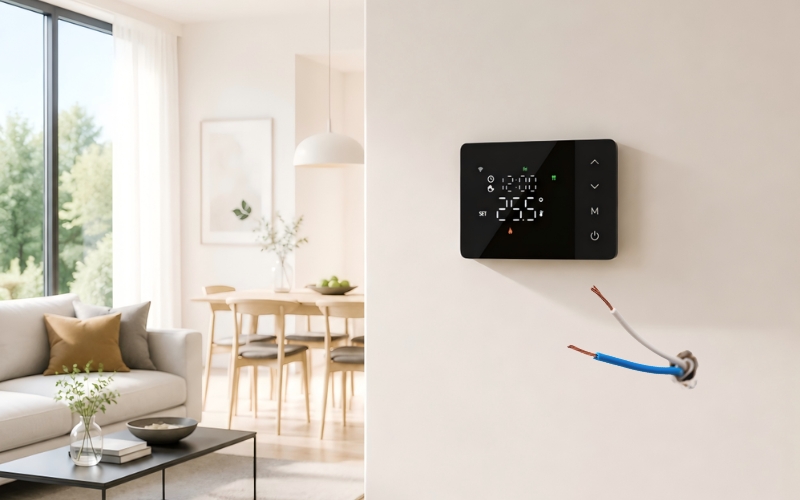
[August, 2026]A practical way to improve room-level heating control without turning a controls upgrade into a full heating-system replacement.Who This Article Is ForThis guide is for HVAC installers, heating contractors, distributors, wholesalers, system integrators, property managers and heating brands working with existing radiator systems. It focuses on the questions that usually decide whether a smart radiator retrofit works well in practice: what is already installed, whether the new thermostat will fit and control the valve correctly, how many rooms need to be connected, and how the radiator controls will work with the boiler.Quick AnswerIf the radiators, pipework and heat source are still in good condition, there is often no reason to replace them just to gain better room control. A compatible smart radiator thermostat can replace the manual thermostatic head and add schedules, remote adjustment and independent room temperatures with relatively little disruption.But the retrofit should start with the existing heating system, not with the app. Check the valve body and valve pin first. Then decide whether WiFi or Zigbee suits the number of rooms and the way the property will be managed. Finally, make sure the boiler control still makes sense when individual radiators begin opening and closing independently.1. The Real Retrofit Opportunity Is at Room LevelA lot of existing radiator heating in Europe is mechanically sound but still controlled in a very traditional way. The boiler produces heat, hot water reaches the radiators, and each room has a manual thermostatic radiator valve. The system works, but control is limited.That is exactly why room-level retrofit can be useful. The aim is not to replace equipment that still has years of service left. It is to improve the part of the system the user interacts with every day.A bedroom does not need to follow the same heating schedule as a living room. A home office may need heat during working hours while a guest room stays at a lower setpoint. With manual valves, those differences depend on somebody walking from room to room and changing them by hand. Smart radiator control makes those room decisions programmable.For many retrofit jobs, this is a much more realistic starting point than rebuilding the complete heating system.2. What Actually Changes When a Manual Valve Becomes Smart?The radiator and valve body can remain exactly where they are. The main change is the thermostat head and the way it commands the valve.A smart radiator thermostat uses a small motor to move the valve according to room temperature and heating demand. Depending on the product and system architecture, the user can change the setpoint at the radiator, from a phone, or through a central smart-heating interface.In day-to-day use, the useful changes are straightforward:· Different rooms can have different temperature setpoints.· Heating can follow a weekly schedule instead of relying on manual adjustment.· Settings can be changed remotely when plans change.· A multi-room system can be managed from one interface rather than radiator by radiator.It is worth being precise about energy saving. A smart TRV does not automatically make a building efficient. If every room is still kept at the same high temperature all day, the technology has very little to optimize. The value comes from controlling where and when heat is needed. When schedules and room setpoints are used sensibly, unnecessary heating can be reduced.3. Start with the Valve Body, Not the Thermostat ScreenThis is one of the most important checks in a radiator retrofit, and it is easy to overlook when the product discussion starts with WiFi, Zigbee or app functions.Before quoting a large quantity of smart TRVs for an apartment project, inspect a few of the existing valves on site. Buildings that look identical on drawings can contain a mix of valve bodies after years of repairs and partial renovations.3.1 Confirm the Mechanical ConnectionThe thermostat head has to fit the valve body correctly. Some common connections can be fitted directly; others need an adapter. If the mechanical interface is wrong, the fact that the thermostat has the right wireless protocol or app is irrelevant.On larger projects, record the valve types during the survey rather than assuming one adapter will cover every radiator.3.2 Check the Valve PinRemove the old head and check that the valve pin moves freely. A pin that has been sticking for years will still stick after a smart head is installed. If the valve body is already failing, fitting a new thermostat on top of it is not the first repair we would recommend.This simple check can prevent a lot of unnecessary troubleshooting later, when a room fails to heat and the new control is blamed first.3.3 Look at Where the Thermostat Will Measure TemperatureRadiator thermostats do not always sit in an ideal place for room-temperature sensing. Curtains, radiator covers, deep window sills and furniture can trap warm air around the device.If the thermostat thinks the room is warmer than it really is, the radiator may close too early. For difficult locations, an external room sensor or another room-temperature reference can be more useful than repeatedly changing calibration values.4. WiFi or Zigbee? Choose Around the Project, Not the Protocol NameBoth WiFi and Zigbee can work well for smart radiator control. The better choice depends on how many devices are involved, how the property is networked and whether the system is likely to grow.Project QuestionWiFi May SuitZigbee May SuitCheck Before SpecifyingHow many devices?A small installation with a limited number of radiators.A whole-home or multi-room system with many devices.Current quantity and likely future expansion.Network approachThe property has suitable WiFi coverage and capacity.A dedicated gateway and local device network are preferred.Coverage, gateway position and who manages the network.ExpansionThe installation is unlikely to grow much.More rooms or devices may be added later.Gateway/device capacity and ecosystem compatibility.User setupDirect connectivity fits the intended user experience.Centralized multi-room management is the priority.App, account, gateway and handover requirements.For one or two radiators, WiFi can be perfectly practical. Once the project becomes a whole apartment, a large house or a multi-room property, it is worth looking at the network as a system rather than simply adding more individual devices.For distributors, this also means WiFi and Zigbee should not be positioned as two nearly identical SKUs. They answer different project needs, and the sales team should be able to explain that difference clearly.5. One Smart Radiator Is a Product. Ten Smart Radiators Are a System.The first device is usually easy. The interesting questions start when several rooms are connected.Which radiators belong to the same room? Which rooms need different schedules? What happens if the internet is unavailable? Where will a Zigbee gateway be installed? Who manages the system after handover? And, most importantly, what is the boiler doing while individual radiator valves open and close?These are not reasons to make the installation complicated. They are reasons to decide the control logic before installing the devices.5.1 Build Zones Around How the Property Is UsedA useful heating zone should reflect the room and its occupancy, not simply the number of radiators. Two radiators in one large living room may need to follow the same demand, while the bedroom next door should have its own setpoint and schedule.This becomes especially important in larger homes, rental properties and multi-room residential projects where the user wants simple control rather than a long list of unrelated devices.5.2 Keep Schedules UnderstandableSmart control makes very detailed scheduling possible, but a complicated schedule is not automatically a good schedule. In most homes, a few clear occupied and reduced periods are easier to live with and easier for an installer to support.If the customer cannot explain the schedule a week after handover, it is probably more complicated than it needs to be.5.3 Leave Room for ExpansionMany users do not convert every radiator on day one. They may start with bedrooms or the living area and add more rooms later. The communication architecture should allow that without forcing the customer to rebuild the system.6. The Radiators and the Boiler Need to Make Sense TogetherRoom-level control is only half of a hydronic heating system. The boiler or other heat source still needs a sensible way to respond to heating demand.Imagine that most smart radiator thermostats have reached their setpoints and closed their valves, but the boiler is still being asked to run by an unrelated central thermostat. The rooms may now have smarter valves, but the overall control strategy has not really been completed.In some homes, keeping the existing central boiler thermostat is perfectly reasonable. The smart radiator thermostats then fine-tune individual rooms while the central thermostat remains responsible for boiler demand.In other projects, especially where more rooms are being controlled independently, it can make sense to coordinate room demand with a boiler thermostat, receiver, relay or compatible control platform.There is no single answer for every property. What matters is that the installer answers both questions before handover:· How will each room regulate its radiator?· How will the boiler know when the building still needs heat?If those two answers conflict, adding more smart devices will not fix the control logic.7. Where Smart Radiator Retrofit Makes the Most SenseExisting Apartments and HousesThis is the clearest application. The heating system still works, but the owner wants better room control, schedules and remote access without opening walls or replacing the radiators.Partial RenovationsNot every renovation is a full refurbishment. Battery-powered smart radiator thermostats can be installed while rooms are redecorated one at a time, without waiting for a complete electrical renovation.Rental and Managed PropertiesSchedules and remote access can help create more consistent heating control, but the management model should be decided first. A landlord, tenant and property manager may need different levels of access. The app setup should follow that reality rather than forcing every property into the same account structure.Homes with Mixed Heating SystemsSome properties use radiators upstairs and underfloor heating downstairs, or combine radiators with another heat source. A smart TRV can still be useful, but it should be treated as one part of the heating system. The user interface may be unified even though the physical control methods are different.8. What a Smart Radiator Thermostat Will Not FixThis is worth saying clearly: not every cold room is a thermostat problem.If a radiator is undersized, the system is badly balanced, circulation is poor, the valve body is damaged or the heat source is not delivering enough heat, replacing the manual head with a smart one will not solve the root cause.When a newly upgraded room does not behave as expected, separate the problem into three areas:· Control: setpoint, schedule, sensing, communication or configuration.· Valve: adapter, valve pin, actuator travel or mechanical condition.· Heating system: flow, balancing, radiator output, circulation or heat-source operation.That distinction sounds basic, but it saves time on site. It also stops a perfectly good thermostat being replaced because the real problem is hydraulic.9. A Practical Retrofit Workflow for InstallersFor a few radiators, the job can be quick. For a larger installation, following the same sequence every time makes commissioning and future support much easier.1) Survey the existing valves. Record connection type, adapter requirements, valve condition and any unusual radiator locations.2) Clarify what the customer actually wants. Remote control, schedules, independent rooms and whole-home management are related, but they are not the same requirement.3) Choose WiFi or Zigbee around the scale of the project and the network environment.4) Define the rooms and zones before pairing devices. Do not leave the control structure until the end.5) Check how the boiler is controlled today and whether that arrangement still makes sense after room-level control is added.6) Install the thermostat and confirm that it can drive the valve correctly.7) Check temperature sensing in the real installation position, especially where curtains or covers affect airflow.8) Commission the complete system: room response, schedules, wireless communication and boiler behavior.9) Show the user how normal overrides and schedules work. A short, clear handover prevents a surprising number of later support calls.10. What Distributors and Wholesalers Should Look at Beyond the ProductFor the channel, smart radiator thermostats can be more valuable as part of a heating retrofit range than as a standalone connected gadget.Before adding models to the portfolio, it is worth checking a few practical points:· Which customers should buy the WiFi version and which should buy Zigbee?· Are the common valve adapters and compatibility information easy for installers to understand?· If Zigbee requires a gateway, is the complete system obvious at the point of sale?· Are battery replacement and normal maintenance expectations clear?· Does the product design fit the residential markets being targeted?· Can the radiator range sit logically beside boiler thermostats, underfloor heating controls and other heating products?The aim is not to carry every possible version. A smaller range with clear application boundaries is usually easier to stock, explain and support.11. Project Checklist Before Ordering Smart Radiator Thermostats² How many radiators will be controlled now, and could that number grow later?² What valve bodies are installed?² Which adapters are required?² Are the valve pins moving freely?² Are any radiators behind curtains, covers or furniture?² Is WiFi or Zigbee the better fit for the project scale?² If Zigbee is used, where will the gateway be located?² How is the boiler or heat source controlled today?² Should room demand be coordinated with boiler demand?² Are schedules required by radiator, room or whole property?² Who will own and manage the app or account after handover?² What spare thermostats or adapters should be kept for future maintenance?12. A Better Way to Think About Radiator RetrofitThe useful comparison is not simply manual valve versus smart valve. It is an existing heating system with limited room control versus the same system with a better control layer.That keeps the project in proportion. If the boiler, radiators and pipework are doing their job, they do not need to be replaced just because the user wants schedules or phone control. At the same time, connected radiator thermostats should not be treated as a complete heating strategy until valve compatibility, room sensing, wireless architecture and heat-source control have been considered.For many existing European homes, that is the practical route: keep what still works, upgrade the control where it adds real value, and make the system only as complex as the building actually needs. Talk to CosyClimate About Smart Radiator Heating ProjectsCosyClimate provides WiFi and Zigbee radiator thermostat solutions for residential heating retrofit, multi-room control and OEM applications.If you are evaluating a project or building a radiator-control range for your market, send us the existing valve type, expected quantity, preferred communication method and how the boiler is currently controlled. We can help you identify the most suitable product and system approach before quotation.Contact CosyClimate  to discuss your next HVAC control project

[July, 2026]IntroductionFan coil systems remain one of the most common HVAC solutions for hotels, offices, apartments and commercial buildings.However, fan coil control projects are becoming more complex. Different applications may require different fan technologies, valve control methods, communication protocols and integration options.The challenge is no longer simply controlling a fan coil unit. The challenge is selecting a thermostat platform that can adapt to different project requirements while reducing installation and commissioning complexity.Quick AnswerA universal FCU thermostat platform allows HVAC professionals to manage different fan coil applications with one flexible solution.A suitable platform can support AC and EC fans, On/Off and 0–10V valve control, Modbus and WiFi communication, heat pump or DX connection through dry contact, external sensors and room card functions.This helps reduce product complexity while improving project flexibility.1. Why Fan Coil Projects Are Becoming More ComplexModern HVAC projects require more than basic temperature control.Common requirements include:• Traditional AC fan control and modern EC fan control• Different valve control methods• Heat pump and DX integration• Modbus communication with BMS• Smart building connectivityAs building owners demand better comfort, efficiency and management capability, the thermostat becomes an important part of the complete HVAC solution.2. The Limitations of Traditional Fan Coil Thermostat SelectionUsing separate thermostat models for different applications creates challenges.Distributors need to manage more inventory.Contractors need to select from more product variations.Integrators need to handle different commissioning processes.OEM manufacturers need to maintain more product versions.A flexible platform reduces these challenges by covering more applications with fewer product families.3. What Makes a Flexible FCU Thermostat Platform Different?3.1 AC and EC Fan CompatibilityTraditional AC fans and modern EC fans require different control methods.AC fans usually use relay outputs for speed selection, while EC fans often require 0–10V signals.A flexible FCU thermostat allows projects to use the appropriate control method without changing the complete control concept.3.2 Flexible Valve ControlDifferent fan coil systems may use different valve technologies.Some applications require On/Off valve control, while others require 0–10V proportional control.Supporting both methods makes one thermostat platform suitable for more HVAC applications.3.3 Communication Options: WiFi and ModbusSome projects only need standalone room control. Others require integration with building automation systems.WiFi supports smart and connected applications, while Modbus provides a reliable solution for BMS integration.A flexible platform can support both requirements.3.4 Additional HVAC FunctionsModern projects often require additional functions beyond temperature adjustment.Examples include dry contact connection for heat pumps or DX systems, external sensors for special applications and room card functions for hotel energy management.4. Benefits for Different HVAC ProfessionalsFor HVAC IntegratorsFlexible communication options and consistent control logic simplify integration and commissioning.For Contractors and InstallersFewer product variations reduce installation mistakes and make project delivery easier.For Distributors and WholesalersA broader application range helps reduce inventory pressure and improve product coverage.For OEM and FCU ManufacturersA universal platform supports different market requirements without developing multiple independent controllers.5. Typical ApplicationsHotel projects:Room comfort, key card functions and BMS integration.Office buildings:Individual room control combined with centralized management.Residential projects:Flexible FCU control for apartments and homes.Retrofit projects:Upgrading existing fan coil systems without replacing equipment.6. Practical Checklist Before Selecting an FCU ThermostatBefore selecting a thermostat, HVAC professionals should confirm:• Fan type: AC or EC• Valve type: On/Off or 0–10V• System type: 2-pipe or 4-pipe• Power supply• Communication requirements• External sensor requirements• Heat pump or DX requirements• Installation environment and quantityConclusionThe future of fan coil control is moving toward flexible platforms rather than isolated thermostat models.For HVAC professionals, the right control platform can reduce selection complexity, simplify installation, improve system integration and support future expansion.A universal FCU thermostat approach helps connect traditional room control with modern connected HVAC systems.Looking for a flexible fan coil thermostat solution?CosyClimate provides universal FCU thermostat solutions supporting AC and EC fans, On/Off and 0–10V valve control, Modbus communication, WiFi connectivity and customized HVAC control requirements.Contact CosyClimate  to discuss your next HVAC control project

<  12345··· >